
Fuel Line Material Comparison: Rubber, Nylon & Stainless Steel
Most people size a fuel line off the old hose. That is the first mistake — an old line has stretched and swollen, and it reads larger than it started. The second mistake is treating every hose as interchangeable. Material decides how a line handles pressure, heat, fuel chemistry, and time, and those four things are what strand a machine in the yard.
On a small engine, the material question is narrower than it looks. The short version: rubber is the default for small engines. Nylon is what OEM machines ship with. Stainless braided is the special case. Everything below is the reasoning behind those three sentences.
Why the Material Matters More Than the Size
A hose that fits and a hose that lasts are two different things. Get the size wrong and it leaks at the fitting on day one — you notice immediately. Get the material wrong and the line works fine for a season or two, then hardens, cracks, or swells and lets go when you least want it to. That is the failure mode nobody catches in the driveway.
The material sets the ceiling on four properties: pressure it can hold, temperature it survives, how it reacts to what is in the fuel, and how long it lasts under vibration. A fuel line is not a universal part. Match the material to the machine and the fuel, and most of the failure modes disappear before they start.
Rubber (NBR) Fuel Hose — What Most Small Engines Actually Need
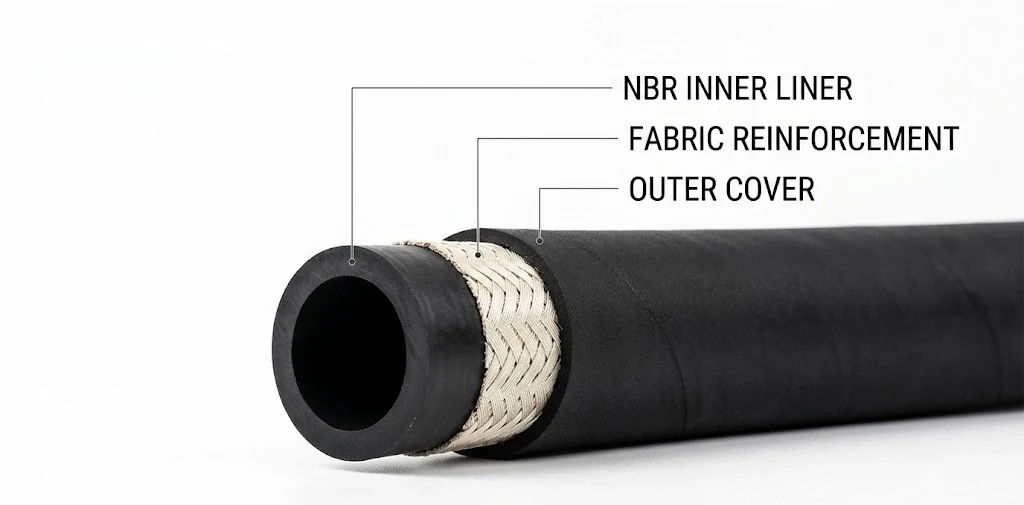
For a walk-behind mower, a riding mower, a portable generator, or a snowblower, the answer is almost always rubber. Specifically, NBR (nitrile) rubber with a reinforcement layer inside — the inner liner contacts the fuel, the fabric layer resists bulging and collapse. This is the material our own small-engine fuel line kits are built around.
What to know about it:
- Construction. Nitrile inner liner, textile reinforcement, rubber outer cover. The reinforcement is what keeps the line from ballooning under pressure or collapsing under vacuum.
- Sizes. Common inside diameters run 3/16″, 1/4″, 5/16″, 3/8″, and 1/2″. On mowers, 1/4″ is the workhorse; 3/16″ often pairs with a 13/32″ outside diameter.
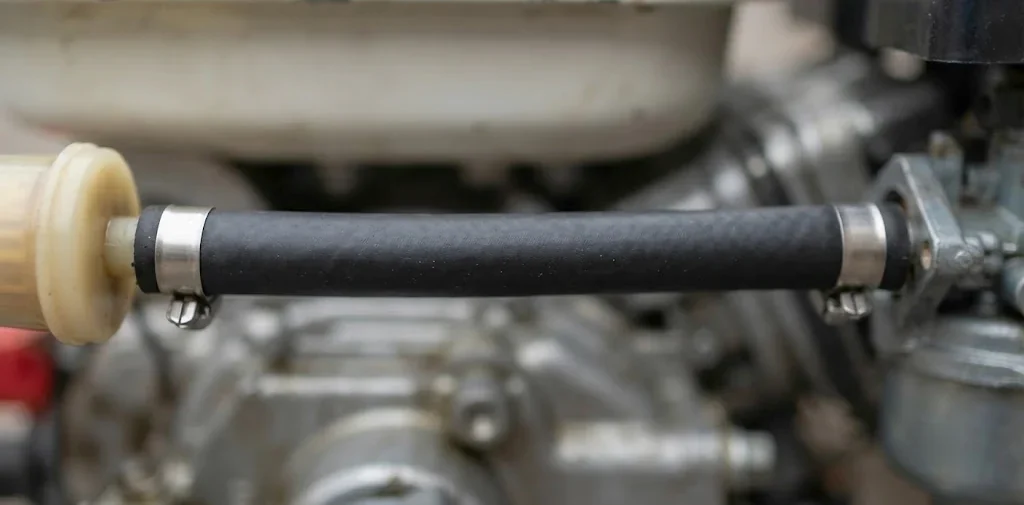
- Fittings. Push-lock (barb) connections are standard. They seat by friction and hold with a clamp, not by threading.
- Standard. SAE J30 R6 covers this class. Working pressure is 50 psi at 3/8″ ID and under, 35 psi above 3/8″ ID, with a minimum burst around 250 psi (1.72 MPa). Temperature range for R6 is -40°F to 212°F.
On R7. Some rubber hose is also rated to SAE J30 R7, which extends the temperature ceiling to 257°F but shares the same pressure table as R6 — 50 psi at 3/8″ ID and under, 35 psi above, same burst figure. If you need the higher heat ceiling, R7 is the call, and you should see the standard number printed on the hose. What the standard allows and what a given supplier ships are always two things, so read the jacket.
On ethanol. NBR rubber has not been tested for a formal ethanol resistance grade, and the manufacturer’s own wording is that service life in ethanol is shortened. Rather than hand out a grade number, here is the standard’s own position: SAE J30 notes that when oxygenates such as ethanol, methanol, or MTBE exceed 5% by volume, permeation rises markedly. That is the honest frame — the fuel matters, and more of it means a shorter life.
Nylon Fuel Tubing — What OEM Machines Ship With
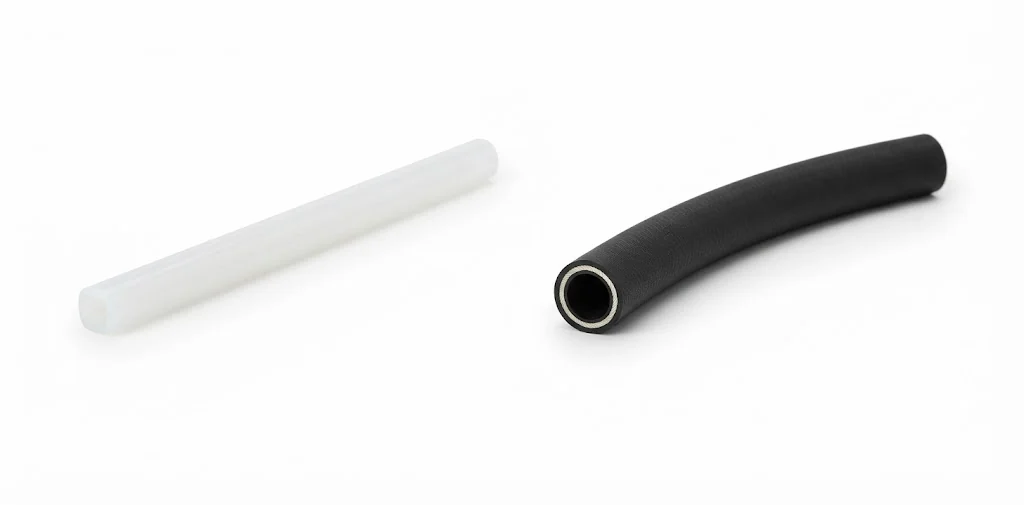
Open the hood on a newer machine and you will often find nylon, not rubber. Nylon is rigid tubing rather than flexible hose, and OEMs use it for reasons that have little to do with performance: it is light, cheap, resistant to fuel, and holds a clean line along a frame. Weight matters to an OEM targeting fuel economy, and nylon routing is a fraction of the weight of equivalent rubber.
It is a good fit for factory fuel supply and return lines, particularly in protected locations where nothing is going to rub or pinch it.
The trade-offs show up with age:
- It goes brittle. Nylon hardens over time, and heat plus ethanol plus vibration accelerate it. A line that flexes fine today can crack at a fitting in a couple of seasons.
- It is not field-repairable in the usual sense. A cracked section means cutting it out and splicing with a barb union and clamps — the tubing itself does not patch.
- It is more exposed to debris damage. Under a deck or along a frame, a nylon line takes stone strikes worse than a rubber one.
Two handling notes from the shop side: use the right quick-connect disconnect tool on OEM fittings — prying them off with a screwdriver damages the sealing O-rings and creates a leak you will chase later. And when you need a bend, warm the tubing with a heat gun rather than forcing it — nylon kinks and whitens at a sharp cold bend, and that kink is a future crack.
Stainless Steel Braided Hose — When It’s Worth It
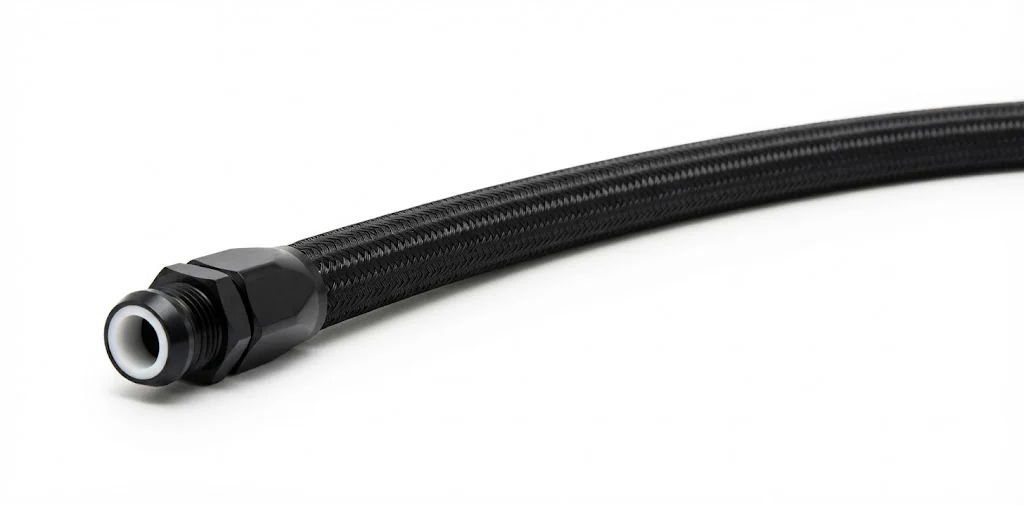
Stainless braided fuel line is a PTFE inner tube inside a woven stainless (or nylon) braid. The braid carries the abrasion and puncture protection; the inner tube carries the chemical resistance. Fittings are aluminum AN (4AN through 10AN), and the standard for this class is R14.
Where this belongs: high-pressure EFI systems, routings that are exposed to heat or mechanical wear, and long-term setups where you do not want to revisit the line. In those applications the braid earns its cost — it resists chafing against a frame, shrugs off road debris, and holds up where a soft hose would be abraded through.
Where it does not: a stock small engine that came with rubber. Braided line costs more, needs proper cutting and AN-style assembly (special tools, not a pocket knife), and wants a larger bend radius than rubber — it does not like being routed tight.
One honest note on price: braided line sits at the higher end of the range, and the fittings and tools add to that. For a mower or a generator, that is cost you do not need to spend. For an exposed, high-pressure EFI run, it is the correct line.
FKM and EPDM — Materials You’ll See Elsewhere
Two more materials turn up often enough that it helps to know what they are for.
FKM (fluoroelastomer). You will find it on some OEM small engines as factory fuel line. It handles heat and fuel chemistry well, and it is a legitimate factory choice — not something to swap in on a carbureted mower. Treat it as “the material some machines ship with,” not as an upgrade to chase.
EPDM. EPDM is a coolant and vacuum-system material. It resists brake fluid and holds up on cooling loops, but gasoline and ethanol blends swell it — on a fuel supply line that swelling cuts burst pressure and can blow a fitting off. The useful takeaway is a buying one: if you are picking a line for a fuel system, EPDM is not the fuel answer. It belongs on the coolant side, where it does its job well.
Matching Material to Machine and Fuel
| Material | Fuel resistance | Common standard | Typical use | Watch-outs |
|---|---|---|---|---|
| Rubber (NBR) | Good on gasoline and diesel; ethanol life untested | SAE J30 R6 / R7 | Small engines: mowers, generators, snowblowers | Hardens with age; replace if stiff or cracked |
| Nylon tubing | Good; OEM standard | OEM quick-connect spec | Factory fuel supply and return on OEM machines | Goes brittle with heat and ethanol; not field-repairable |
| Stainless braided (PTFE-lined) | Excellent, all fuels | R14 | High-pressure EFI, exposed routing | Cost; needs AN fittings and special tools |
| FKM (fluoroelastomer) | Excellent | OEM spec | Some OEM small engines | Higher cost; not our primary line |
| EPDM | Poor on gasoline | — | Coolant and vacuum, not fuel | Do not use as a fuel line |
| Material | Fitting type | Clamp type |
|---|---|---|
| Rubber (NBR) | Barb / push-lock | Fuel-injection style smooth-band clamp |
| Nylon tubing | Quick-connect | Integrated retaining clip |
| Stainless braided | AN flare | Wrench-tightened AN nut |
The decision, stated plainly:
- Mower, generator, snowblower, most small engines → rubber (NBR), sized to the machine.
- Restoring an OEM machine to factory routing → nylon tubing.
- High-pressure or exposed EFI routing → stainless braided.
Sizes, Clamps, and Fitting — Getting It Right
This is where most callbacks actually come from, and none of it is complicated.
Sizes. For riding mowers, 1/4″ is the common inside diameter. 3/16″ is often specified with a 13/32″ outside diameter. Some 5/16″ line is marked EFI-only, so read the jacket before you assume it is a generic replacement. Measure the fitting, not the old hose — the old hose has stretched.
Clamps. Match the clamp to the outside diameter, not the inside: a 1/2″ OD line takes a clamp marked 1/2″; a 13/32″ OD line takes one marked 7/16″. And replace the clamps with the hose. Old spring clamps have taken a set and will not hold the same tension against a new, slightly thicker wall.
Installation. Cut the end square — a ragged cut will not seat on the barb. To ease a fitting on, a little clean oil or ATF works; skip gasoline and diesel as lubricants. And never heat a hose end with an open flame to soften it, which ruins the material; hot water is the right way if you need a flexible end.
Inspection. Check the line for hardening, cracking, bulging, a spongy feel under the fingers, and the smell of fuel with no visible leak. Any of these means replace, not wait.
Service life. There is no fixed year count to quote, so use the manufacturer’s own intervals: Kohler specifies 200 operating hours before replacement; Honda’s small-engine schedule lists a 2-year fuel tube check (“replace if necessary”); Briggs & Stratton judges by condition. Follow the engine maker’s interval, and inspect in between.
FAQ
What fuel line material is best for a lawn mower?
Rubber (NBR), sized to your machine — usually 1/4″ ID on a rider. It handles the pressure and temperatures a small engine produces, and it is the material these machines were designed around.
Can I replace a nylon fuel line with rubber hose?
Yes, if the fittings allow it. The catch is the connection: nylon usually runs on quick-connect fittings, and rubber runs on barbs with clamps. Match the fitting type to the hose, not just the diameter — that mismatch is a common source of leaks.
Does ethanol in pump gas damage these fuel lines?
It affects service life. NBR rubber has not been tested to a formal ethanol grade, and the standard’s own note is that above 5% oxygenate by volume permeation rises markedly. If your equipment sits with ethanol fuel in it, expect a shorter life and inspect more often.
How do I know when a fuel line needs replacing?
Look for a line that is stiff instead of supple, cracked at a fitting, bulging, or spongy, or that smells of fuel without a visible drip. On intervals, follow the engine maker: Kohler lists 200 operating hours, Honda calls for a 2-year check with replacement if needed.
What size fuel line does my small engine take?
Measure the fitting rather than the old hose, and check whether your machine uses barbs or quick-connects. If you are choosing a kit instead of one length, choose the right fuel line size walks through it.
The One Thing to Take Away
If you remember nothing else: pick the material before you pick the size. Rubber for small engines, nylon for OEM restoration, braided for high-pressure or exposed routing. A line that fits but is the wrong material just fails later, usually somewhere inconvenient. When a line does start to go, the cause is usually the same handful of things — why fuel lines start leaking covers them.
Rubber and PTFE-based braided line are not competing answers to the same question — they serve different jobs, and rubber vs PTFE fuel line looks at where each belongs.
For a complete replacement set sized for small engines, the rubber fuel line hose kit covers the common diameters with clamps included.
Tell us your engine and fuel type — we’ll match the material and size