
The easiest way to size a fuel line is to pull the old one off and match it at the parts counter. It’s also the most common way to get the wrong size. Old hose swells, stretches, and takes a permanent set around every fitting it has ever touched. Measure it and you are measuring its history, not its specification.
There is a better reference point sitting right in front of you: the fitting. Measure that, and the guesswork disappears. This guide sticks to one subject: how to get an accurate number off a small engine fuel system, with tools you probably already own.
Why the Old Hose Lies to You
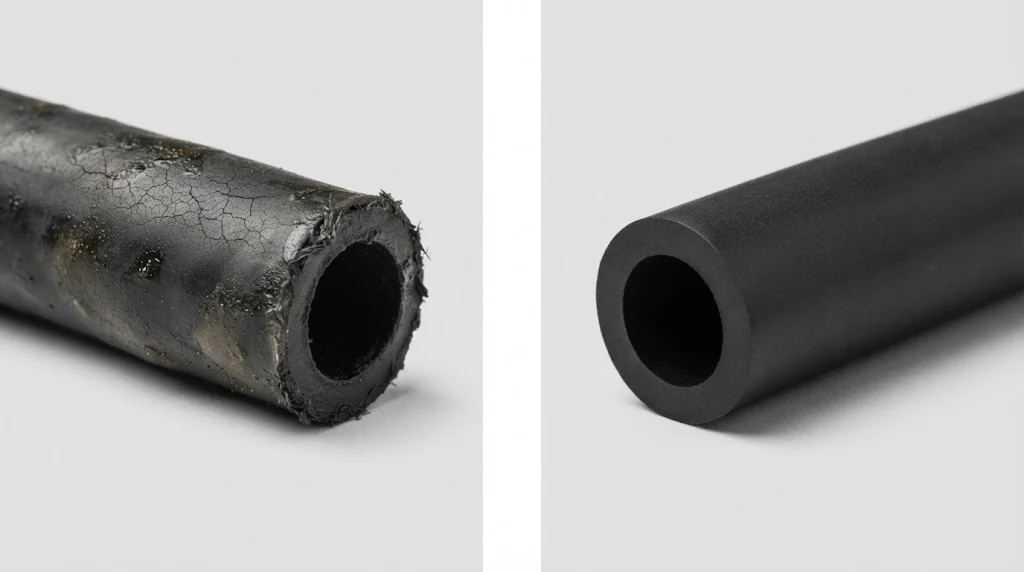
Fuel line is a wear item, and it deforms as it ages. Three things happen at once:
- The bore swells. Rubber absorbs fuel components and softens. A line that started at 1/4 in can measure noticeably larger after a few seasons in service.
- The ends stretch. Every time the hose is pushed onto a barb, the material around that barb stretches and stays stretched. The section at the tank outlet is usually the most distorted part of the whole run.
- The outside gets abraded. Chafing against a shroud or a frame rail thins the wall, which changes the outside diameter but not the inside.
Cut a section from the middle of the run and you get a number that is closer to correct, but still not a specification. A swollen line measured at 0.27 in does not mean you need a 0.27 in hose. It means the hose you removed was 1/4 in and has aged.
If you already know your size and just want the table, the fuel line size chart has all five sizes side by side.
The One Tool You Need (and What to Skip)
A basic digital caliper is sufficient for this job. So is a decent dial caliper. There is no need for lab-grade equipment or a calibrated metrology setup — you are measuring a rubber hose to the nearest 1/64 in (about 0.4 mm), not machining a bearing seat.
What to skip:
- A tape measure. The hook at the end adds its own thickness, the blade flexes, and reading across the curved face of a hose introduces error in both directions.
- A steel ruler laid across the end. This depends on sighting perfectly perpendicular to the cut face, and almost nobody can. The parallax alone is worth 1/32 in.
- Eyeballing it against a known hose. “Looks like a quarter inch” has cost more people a second trip to the store than any other method.
A caliper with 0.01 mm resolution is more precision than the job requires, but it is cheap, it holds a reading on its display, and it reaches into tight spaces where a ruler cannot go.
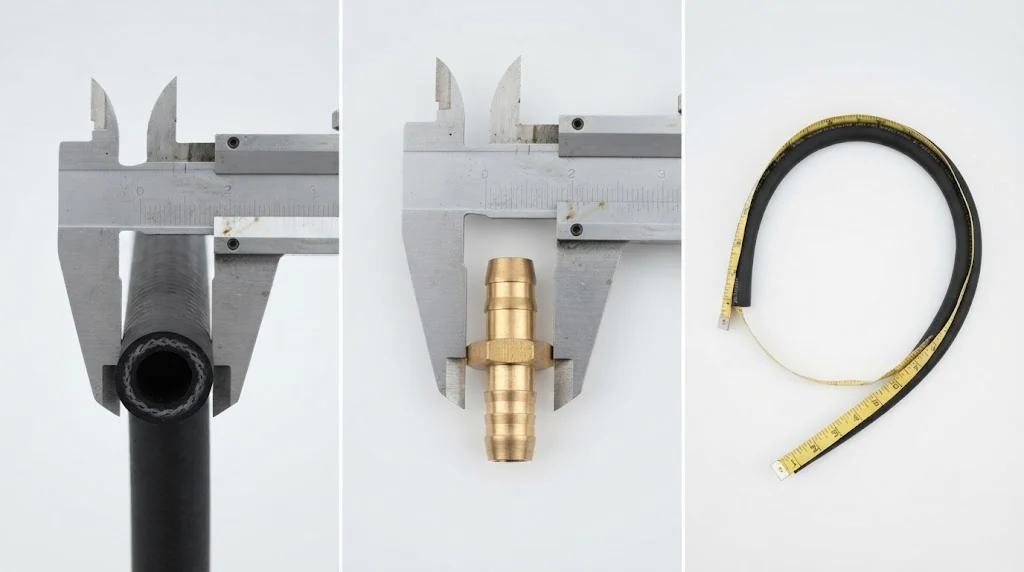
Where to Measure: The Fitting, Not the Hose
The reliable reference is the metal fitting the hose slides onto — the barb, the nipple, or the tank outlet spud.
1. Clean the fitting. Wipe off fuel residue and any hardened rubber left behind by the old line. A film of rubber will read as diameter.
2. Find the bead. Most small engine barb fittings have a raised ring, or bead, near the base that creates the seal. Generally measure across the bead — that is the widest part of the fitting and the point the hose has to pass over.
3. Close the caliper jaws on the bead, not on the threads. If the fitting has a threaded section above the barb, ignore it entirely. Threads are a different measurement class and have nothing to do with hose size.
4. Do not measure at the very tip. The tip is chamfered to help the hose start. The tip diameter is smaller than the bead and will give you an undersized reading.
5. Measure more than one fitting. Tank outlet, fuel filter inlet, carburetor inlet. If the numbers disagree, size the hose to the largest one — the hose has to pass over all of them.
Write the number down. You will want it at the counter.
Reading the Number: ID vs OD in One Paragraph
A caliper on the bead gives you an outside diameter — the outside of the metal barb. Hose is sold by inside diameter. These are not the same number, and they are not supposed to be. The hose has a wall thickness plus, in reinforced constructions, a textile or wire layer inside that wall. The inside diameter is what has to grip the barb; the outside diameter is what the clamp has to close around. When you measure a 1/4 in barb and it reads about 0.25 in across the bead, you want 1/4 in ID hose — not hose with a 0.25 in outside diameter, which would be a much smaller, thinner line.
The Clamp Rule
Clamps are sized by the outside of the hose, not the inside.
| Hose ID | Typical hose OD | Clamp to buy |
|---|---|---|
| 3/16 in | 13/32 in | 7/16 in |
| 1/4 in | ~7/16 in | 7/16 in |
| 5/16 in | ~1/2 in | 1/2 in |
| 3/8 in | ~5/8 in | 5/8 in |
If the clamp is labeled by hose inside diameter instead — many small engine clamps are — then match the label to the hose ID directly. What you want to avoid is buying a clamp whose range sits at the very top of its travel. A clamp squeezed fully closed to reach the hose has no reserve left and will not hold tension as the rubber relaxes.
Three Common Measurement Mistakes
1. Measuring the old hose. Covered above, and still the most frequent error. The old line tells you what it used to be, roughly, if you know how much it has aged. It does not tell you what to buy.
2. Measuring the threads or the base of the fitting. Threads sit above the barb, and the base of the fitting often has a shoulder that is larger than the bead. Either one gives a number that has nothing to do with the hose.
3. Using a tape or eyeballing it. A 1/16 in error is a full size step in small engine fuel line. There is no size between 1/4 and 5/16 to fall back on. Get it wrong and the hose either will not go on or will not seal.
When You Can’t Measure (Machine Spec Fallback)
If your machine turns out to take the most common size, the 1/4″ fuel line page covers what to buy.
Sometimes the fitting is buried under a shroud, or the engine is still hot, or the machine is not in front of you at all. In that case, fall back to the machine’s specification:
- Check the engine manual. Kohler, Briggs & Stratton, and Honda all publish fuel line routing and size information for their small engines. Honda’s service schedule, for example, calls for inspecting the fuel line every two years; Kohler’s maintenance interval calls for fuel system service at 200 operating hours. Use the manual’s size figure as a starting point.
- Look it up by machine class. Riding mowers, walk-behind mowers, generators, and snow throwers do not all use the same line size. A fuel line size chart organized by machine type will narrow the field to one or two candidates.
Then confirm with a caliper when you have access. A manual figure is a good prior, not a substitute for the fitting in front of you — aftermarket replacement parts and previous repairs can leave a machine with a fitting that does not match its original build sheet.
FAQ
What size fuel line is 1/4 ID?
1/4 inch fuel line is the mainstream size on North American small engines and has the densest OEM part number coverage. Its outside diameter is typically around 7/16 in, which is the clamp size you want. If you measured a barb at roughly 0.25 in across the bead, this is the line to buy.
Can I measure fuel line with a ruler?
You can get close, but not close enough to be reliable. A steel ruler held across the cut end depends on a perfectly square cut and a perfectly perpendicular sight line, and a tape measure adds its hook thickness to every reading. A basic caliper costs less than a second trip to the store.
What if my fuel line has no markings?
Most small engine fuel line has no size marking at all. Measure the fitting instead. The metal does not change size with age, and the barb’s bead is the dimension the hose actually has to fit.
Is OD the same as ID?
No. Inside diameter is the bore the fuel flows through and the dimension hose is sold by. Outside diameter includes the wall and any reinforcement layer, and it is the dimension clamps are sized to. A hose with a 1/4 in ID typically measures around 7/16 in OD.
What size clamp for 1/4 fuel line?
7/16 in for most 1/4 in ID hose. Check the hose’s actual outside diameter with your caliper before buying — wall thickness varies between constructions, and a reinforced line will run slightly larger than a plain one.
Picking the Right Line
Once you have the fitting measurement, the rest is straightforward: match the inside diameter, pick a clamp that lands in the middle of its range rather than at the end, and replace the line before it hardens rather than after it cracks. A line that has gone stiff enough to hold its shape when you bend it is already past due.
If you would rather start from a complete fuel line kit — hose, clamps, and the right size in one box — that removes the sizing question entirely.