
Your mower won’t start. You pull the fuel line off, hold it up next to the old one, cut a new piece, and… it leaks at the fitting. Or it’s too loose and slides off. Either way, you’re back in the yard with a leaking machine.
Almost every time, the problem isn’t the hose. It’s the size.
Here’s the short version: 1/4″ inside diameter is what most small engines take. If you’re working on a newer EFI machine, it might be 5/16″. Handheld equipment often runs smaller. The chart below sorts it out, and the section after it shows you how to measure when you’re not sure.
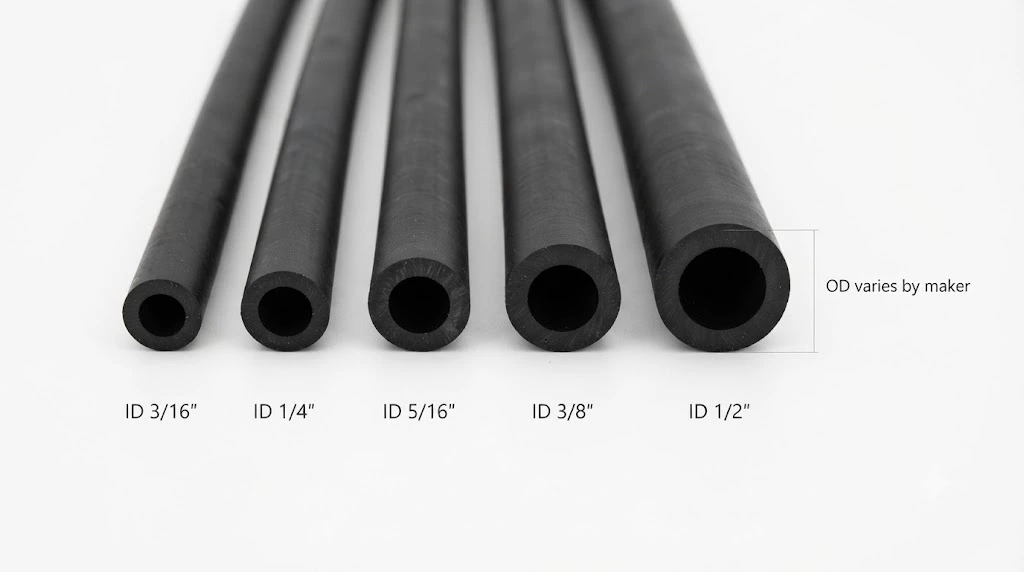
Fuel Line Size Chart
Inside diameter (ID) is the number that matters. That’s the hole the fuel flows through, and it’s what has to match the fitting on your carburetor or fuel tank.
| ID (inside) | OD (outside) | Common on | OEM part number reference |
|---|---|---|---|
| 3/32″ | — | Handheld: string trimmers, chainsaws | B&S small-engine line |
| 1/8″ | — | Handheld: trimmers, small chainsaws | B&S small-engine line |
| 3/16″ | 13/32″ | Common in repair shops and aftermarket kits; ID only on four-stroke engines | Stens 115-303 (aftermarket) |
| 1/4″ | 1/2″ or 7/16″ | Most common — riding mowers, push mowers, snow blowers | Kohler 2511139-S · B&S 791766 |
| 5/16″ | — | EFI engines only | Kohler 25 111 37-S (marked EFI Only) |
| 3/8″ | 9/16″ | Larger displacement equipment | — |
| 1/2″ | 3/4″ | Large flow applications | — |
Three things worth knowing about that table:
1/4″ is the workhorse. If you own a riding mower, a walk-behind, or a snow blower, there’s a very good chance it takes 1/4″ ID. It’s the size with the most OEM part numbers behind it, which tells you where the volume is.
5/16″ is not a bigger version of 1/4″. It shows up on EFI (electronic fuel injection) engines specifically — Kohler’s 25 111 37-S is marked EFI Only. Putting 5/16″ on a carbureted mower because it “looks about right” is how you get a loose connection.
3/16″ is common in shops, but check your machine. It’s widely sold as an aftermarket size (Stens 115-303 is one: 3/16″ ID, 13/32″ OD), yet we couldn’t find OEM fuel line part numbers in that size. One caution: on two-stroke handhelds, a “3/16” spec often refers to the outside diameter — those machines usually take 3/32″, 5/64″ or 0.080″ ID. On four-stroke engines 3/16″ is an inside diameter.
> One honest note: the OD column has blanks. Outside diameter varies by manufacturer and by the reinforcement layer, and we’d rather leave a cell empty than print a number nobody can back up. Measure the fitting, not the old hose.
Want to buy by size? Each size has its own page with part numbers and clamp sizing:
1/4″ · 5/16″ (EFI) · 3/8″ · 1/2″
How to Measure Your Fuel Line
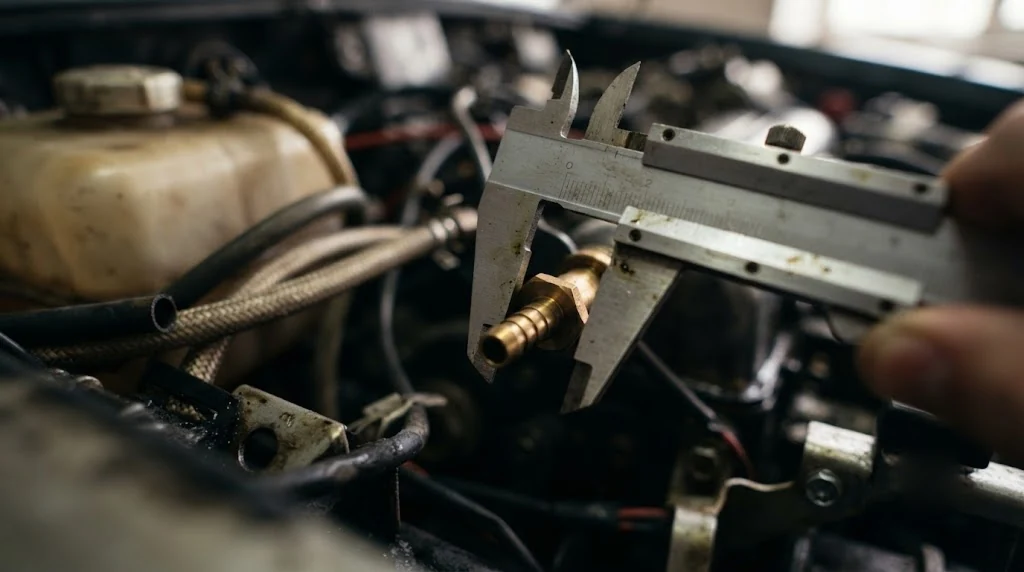
You need one tool: a caliper. A cheap digital one is fine.
Step 1: Measure the fitting, not the hose
This is the mistake that starts most leaks. An old fuel line has been sitting in fuel, swelling and stretching for years. It reads larger than it started. Cut a new hose to match the old one and it’ll be too big.
Instead, measure the barb or nipple the hose slides onto — the metal part on the carburetor, fuel tank, or filter.
Step 2: Read the outside diameter at the widest point
Slide the caliper jaws over the barb. You want the widest point, which is usually the raised ring near the base.
Step 3: Match ID to that number
The hose’s inside diameter should match the fitting’s outside diameter. That’s the interference fit that keeps fuel from seeping past the clamp.
For hose-to-hose splices, measure both ends and go with the tighter match.
You don’t need to be perfect to the thousandth. Within a few hundredths of an inch is fine. What you can’t do is guess — “close enough” is exactly how a fuel line works loose two weeks later. For the full walkthrough with a caliper, see how to measure fuel line.
ID vs OD: The Mistake That Causes Leaks
A quick decoder, because parts listings throw both numbers at you:
- ID (inside diameter) — the hole. This is what you match to the fitting. This is the size of your fuel line.
- OD (outside diameter) — the outer shell, including the reinforcement and rubber cover. This is what you match to a clamp.
So a hose can be “1/4 inch” and measure nearly 1/2 inch across the outside. Both are true. If you order by OD when you needed ID, you get a hose that’s too small for the fitting.
The clamp rule follows from that: clamps are sized to OD, not ID. A 1/2″ OD hose takes a clamp marked 1/2″. A 13/32″ OD hose takes one marked 7/16″.
Three Things That Decide a Good Fit
Size is the first filter. These three decide whether the line actually holds.
Wall thickness. Two hoses can both say 1/4″ ID and behave differently. A thicker wall resists collapsing when the line is under vacuum and holds clamp pressure better. Thin-wall line is fine for a short run to the carb; thicker is better where the hose bends or runs near heat.
Reinforcement layer. Look inside a cut end — the better small-engine lines have a woven or spiral reinforcement between the inner liner and the outer cover. That layer is what stops the hose ballooning under pressure and kinking at a bend. A plain single-layer rubber hose works, but it won’t last as long in a tight routing.
Compatibility with what’s in the tank. Rubber fuel line handles gasoline and diesel. It is not rated for high-percentage ethanol, and SAE J30 notes that once oxygenates pass 5% by volume, permeation rises markedly — fuel slowly sweats through the wall. If your machine sits for months with pump gas in it, you’ll replace the line sooner than the hour meter suggests.
None of this changes the size you buy. It changes which 1/4″ hose you should pick.
What Size Does My Machine Take?
Use this as a starting point, then measure to confirm.
| Machine | Typical ID | Notes |
|---|---|---|
| Riding mower | 1/4″ | Most common size on riders |
| Walk-behind / push mower | 1/4″ (or 3/16″ ID on four-stroke) | Check the fitting — both appear |
| Snow blower | 1/4″ | Same family as riders |
| String trimmer / weed eater | 3/32″ – 1/8″ | Handheld machines run small |
| Chainsaw | 3/32″ – 1/8″ | Small line, tight bends |
| Generator | 1/4″ | Larger units may differ |
| EFI-equipped equipment | 5/16″ | Marked EFI Only on the OEM part |
When to Replace a Fuel Line
Rubber fuel line doesn’t fail on a schedule. It fails when it’s done — and there’s no manufacturer publishing a “replace every X years” number for small engines. What they publish is an interval to check.
Here’s what the engine makers actually say:
- Kohler: replace the fuel line every 200 operating hours.
- Honda: check the fuel tube every 2 years (replace if necessary).
- Briggs & Stratton: judge by condition — no fixed interval.
Check the line at the start of every season, and replace it when you find any of these:
- Stiff or hard — a good fuel line feels supple. If it crackles when you bend it, it’s done.
- Cracked or split, especially near the fitting or where it bends.
- Swollen or soft — a spongy line that collapses when you pinch it.
- Smells like fuel with no visible drip. That’s permeation, and it doesn’t fix itself.
- Bulging at a clamp or fitting.
Replace the clamps when you replace the hose. Old spring clamps have taken a set and won’t hold tension against a new, slightly different wall thickness.
Five Mistakes That Cause Comebacks
1. Cutting to match the old hose. It stretched. Measure the fitting.
2. Using gasoline as a lubricant. It dries out the rubber. Use a drop of clean oil or ATF to slide the hose on.
3. Heating the hose end with a flame. It ruins the material. Hot water is the right way if you need a flexible end.
4. Reusing old clamps. They’ve lost their tension. New hose, new clamps.
5. Assuming ethanol is fine because the hose “looks okay.” Rubber fuel line hasn’t been given a formal ethanol resistance grade, and SAE J30 notes that when oxygenates such as ethanol exceed 5% by volume, permeation rises markedly. If your machine sits with pump gas in it, expect a shorter service life and check more often.
Installing It Right
Once you have the correct size, the install is ten minutes. The details that matter:
Cut it square. A ragged end won’t seat on the barb and will leak under the clamp. Use sharp cutters, one clean squeeze.
Slide it all the way home. The hose should sit past the barb’s raised ring, not hanging on the tip. Push until it bottoms out.
Lubricate with oil, not gas. A drop of clean engine oil or ATF lets the hose slide on without tearing the inner liner. Gasoline dries the rubber and starts the aging process early.
Position the clamp behind the barb ring. The clamp should sit just behind the raised ring, squeezing the hose against the flat of the fitting. Put it on the ring itself and it can’t compress properly.
Don’t over-torque. Enough to hold the hose still when you twist it, no more. Overtightening cuts the liner and creates the leak you were trying to prevent.
Check for kinks. Route the line with gentle curves. A kink starves the carburetor and looks exactly like a dirty carb — which is how people end up rebuilding a carburetor that was never the problem.
Prime and check. Turn the fuel valve on and watch the connections for a minute before you start the engine. A seep shows up fast at the fitting.
FAQ
What size fuel line does a lawn mower take?
Most riding mowers and walk-behinds take 1/4″ ID. Some four-stroke push mowers use 3/16″ ID — but on two-stroke handhelds, a “3/16” spec is often the outside diameter, so check the fitting either way.
Is 5/16 fuel line the same as 1/4?
No. 5/16″ is a larger inside diameter that shows up on EFI engines — Kohler’s 25 111 37-S is marked EFI Only. Putting it on a carbureted machine gives you a loose fit.
Can I use a bigger fuel line if I clamp it tight?
Don’t. A clamp can’t seal a gap that size, and the hose will work loose or draw air. Match the ID to the fitting.
How do I know if my fuel line is too big?
It slides on with no resistance, or you can twist it on the fitting. A correct fit needs a little push and holds snug before the clamp goes on.
Do I need special fuel line for ethanol gas?
Rubber fuel line isn’t rated by ethanol percentage, and SAE J30 notes that above 5% oxygenate by volume, permeation goes up noticeably. Use fresh fuel, don’t let it sit for months, and check the line each season.
How often should I replace the fuel line?
Follow the engine maker: Kohler lists 200 operating hours, Honda calls for a 2-year check with replacement if needed, and Briggs & Stratton judges by condition. In between, inspect it at the start of each season.
Can I use automotive fuel line on a small engine?
It’ll fit if the ID matches, but small-engine line is formulated for the smaller diameters these machines use. Match the ID first, then pick a line rated for fuel.
Why does my new fuel line keep coming off?
Usually a size mismatch — the hose is larger than the fitting — or a clamp that’s sized to the hose instead of the fitting. Check ID against the barb, and size the clamp to the hose OD.
Not sure which size you need? Measure the fitting with a caliper, or match your machine to the chart above. ShineYoo fuel line kits come in the common small-engine sizes with clamps included, so you’re not hunting for parts in the middle of a repair.
*Browse ShineYoo fuel line kits →*