
If you’re on this page, you’ve probably already worked out that your machine takes 1/4″ fuel line — either from the full fuel line size chart or from the old hose in your hand.
This page covers just that one size: what 1/4″ means, which machines use it, the OEM part numbers that match, and which clamp goes with it. No need to sort through five sizes when you only need one.
What “1/4 Inch” Actually Means
Three sentences, because you’ve probably read the long version already:
1/4″ is the inside diameter (ID) — the hole the fuel runs through. That’s the number that has to match your fitting.
The outside is bigger. A 1/4″ ID hose typically measures 1/2″ or 7/16″ across the outside, because the wall and reinforcement layer add to it.
Buy the hose by ID, buy the clamp by OD. Those are two different numbers on the same hose, and mixing them up is how people end up with a clamp that won’t tighten or a hose that won’t seal.
If you’re not sure which number you’re holding, how to measure your fuel line walks through it with a caliper.
Machines That Take 1/4″ Fuel Line
This is the most common small-engine fuel line size in North America — it has more OEM part numbers behind it than any other size, which tells you where the volume is.
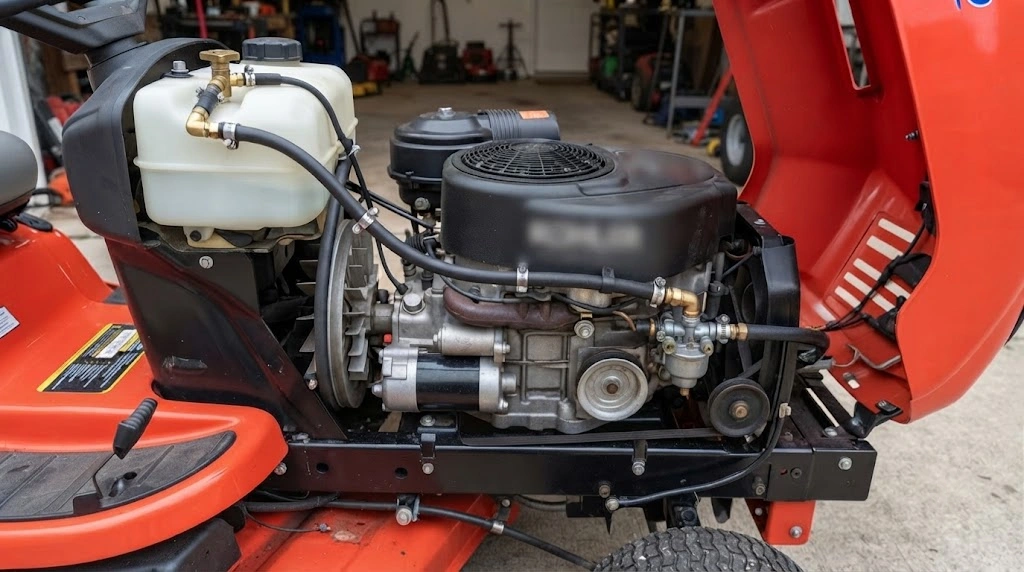
- Riding mowers — the main one. Most riders run 1/4″ from tank to filter to carburetor.
- Walk-behind / push mowers — many use 1/4″, though some four-stroke decks run 3/16″ ID. (On two-stroke handhelds, a “3/16″ spec is often the outside diameter — those take 3/32” or similar ID.)
- Snow blowers — same family as riders, same size.
- Generators — most portable units use 1/4″; larger sets can differ.
A typical riding mower uses roughly 5 feet of 1/4″ line for a full replacement, depending on routing. Measure your run before you cut — and measure the fitting, not the old hose.
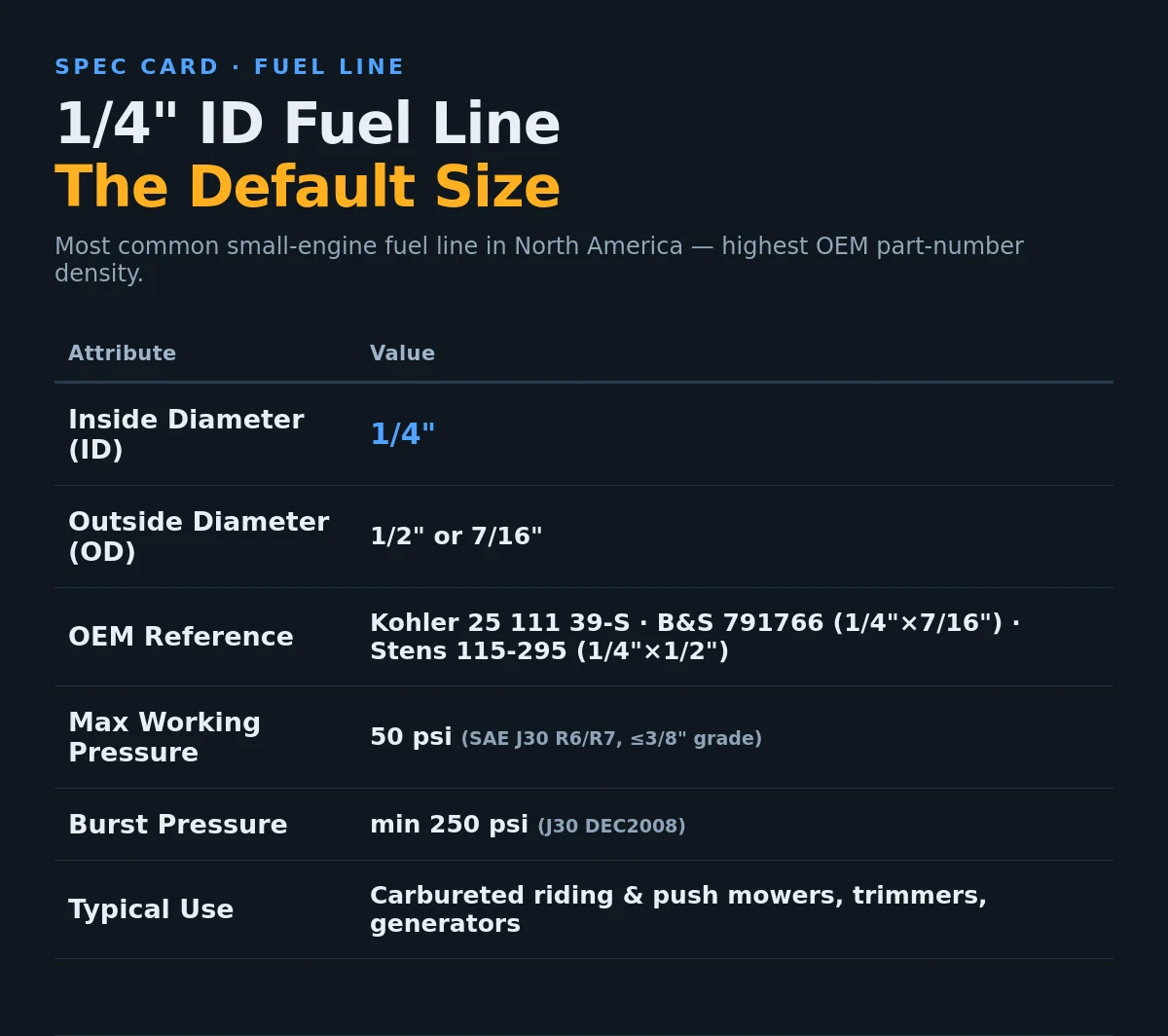
The Spec Sheet for 1/4″ Fuel Line
| Spec | Value |
|---|---|
| Inside diameter (ID) | 1/4″ |
| Outside diameter (OD) | 1/2″ or 7/16″ (varies by manufacturer) |
| OEM part number references | Kohler 25 111 39-S · B&S 791766 (1/4″ × 7/16″ × 15″) · Stens 115-295 (1/4″ × 1/2″) |
| Working pressure | 50 psi max (SAE J30 R6/R7, 1/4″ falls in the ≤3/8″ band) |
| Burst pressure | 250 psi min (SAE J30 DEC2008) |
| Common applications | Riding mowers, push mowers, snow blowers, generators |
Three things worth repeating about that table:
1/4″ is the size with the most OEM support. If your machine’s parts list shows a fuel line in the 1/4″ family, you’re on the most-supported size there is.
The ID is printed on the hose. A good fuel line carries its inside diameter on the jacket — read it before you assume.
OD varies. 1/2″ and 7/16″ are both common for 1/4″ ID, and the reinforcement layer differs by maker. If you can’t read a spec, measure the fitting.
Which Clamp Size Goes With It
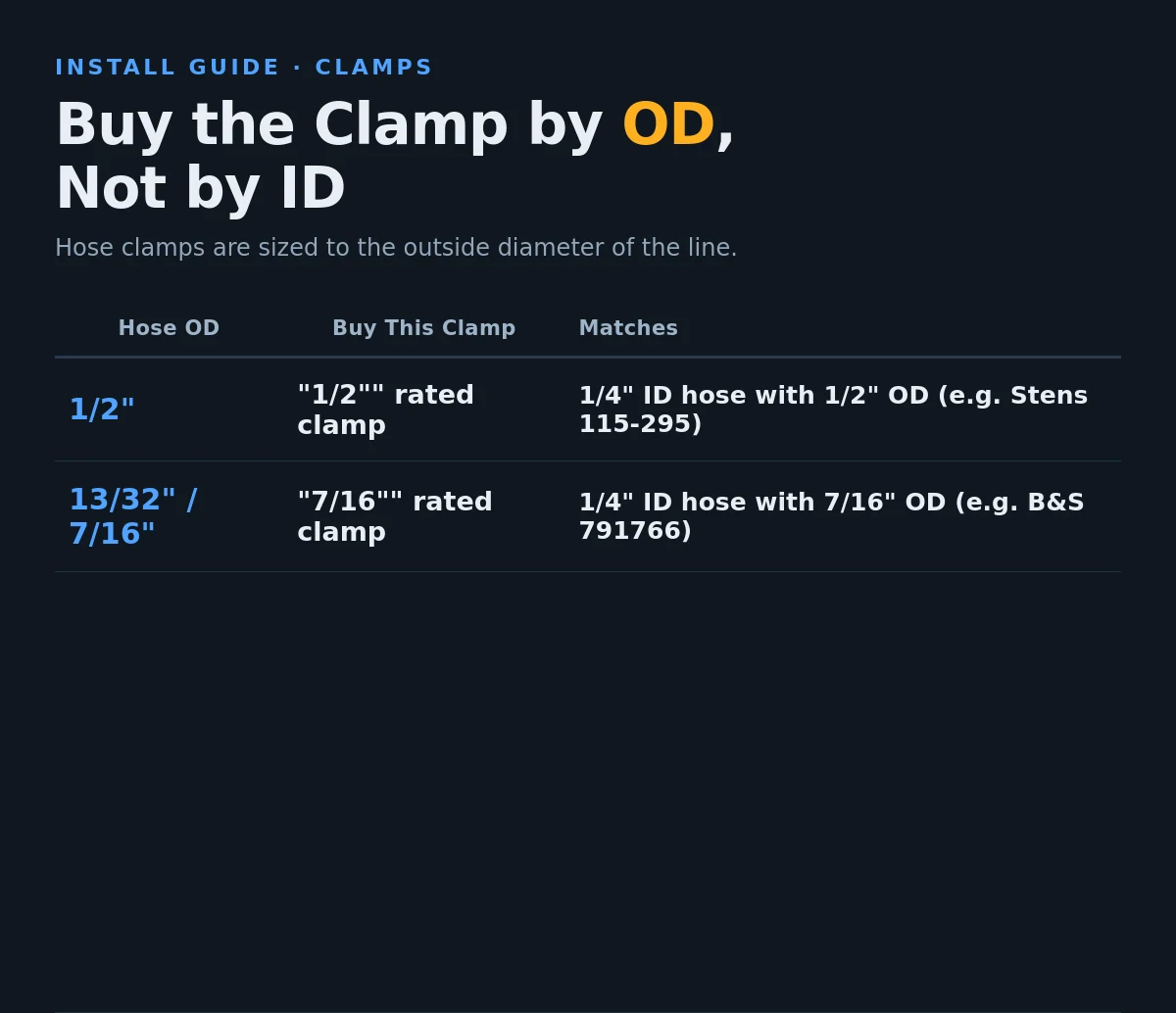
Clamps are sized to the outside diameter, not the inside. So:
- A 1/2″ OD hose takes a clamp marked 1/2″.
- A 13/32″ or 7/16″ OD hose takes a clamp marked 7/16″.
Get this backwards and the clamp won’t compress the hose properly, no matter how hard you tighten it.
And replace the clamps when you replace the hose. Old spring clamps have taken a set and won’t hold the same tension against a new, possibly thicker wall. A new hose with a tired clamp is a leak waiting for a heat cycle.
Three 1/4″ Mistakes Worth Avoiding
1. Cutting the new hose to match the old one. An old line has swollen and stretched. It reads bigger than it started. Measure the fitting.
2. Buying by outside diameter. A “1/2 inch” hose could be 1/4″ ID or something else entirely — the number on the package tells you which. Buy by ID.
3. Making a different size “work.” A universal line that’s close but not right will leak, slide off, or draw air. Matching the size takes two minutes; chasing a lean-running engine takes an afternoon.
One exception worth knowing: if your machine is EFI (electronic fuel injection) rather than carbureted, the size may be 5/16″ instead — see 5/16″ (EFI) fuel line.
FAQ
Is 1/4 fuel line universal?
No. It’s the most common small-engine size, but some four-stroke machines use 3/16″ ID and EFI engines can use 5/16″. It’s the most likely size — not the only one.
What OD fits a 1/4 ID hose?
Commonly 1/2″ or 7/16″, depending on the manufacturer and wall thickness. Both are normal. Match your clamp to whichever your hose actually measures.
How long of a fuel line does a riding mower need?
Roughly 5 feet for a typical full replacement, depending on how the line is routed. Measure your run before cutting.
Can I reuse the old clamps?
Replace them. Old clamps lose tension, and a new hose with a fatigued clamp is a common source of seeps at the fitting.
What pressure does 1/4″ fuel line handle?
SAE J30 R6/R7 line in this size is rated 50 psi maximum working pressure, with a 250 psi minimum burst (DEC2008). That’s far above what a small engine’s fuel system sees.
Need 1/4″ fuel line? ShineYoo kits come in the common small-engine sizes with clamps included — complete fuel line kits.
*Ready to buy? Get the fuel line kit →*