
If you’re looking at 1/2″ fuel line, this is the high-flow end of the small-engine range. It’s not a common size — most mowers run 1/4″ — so it’s worth confirming you actually need it before ordering.
This page covers what 1/2″ is for, its (lower) pressure rating, and the mistakes that come with going big.
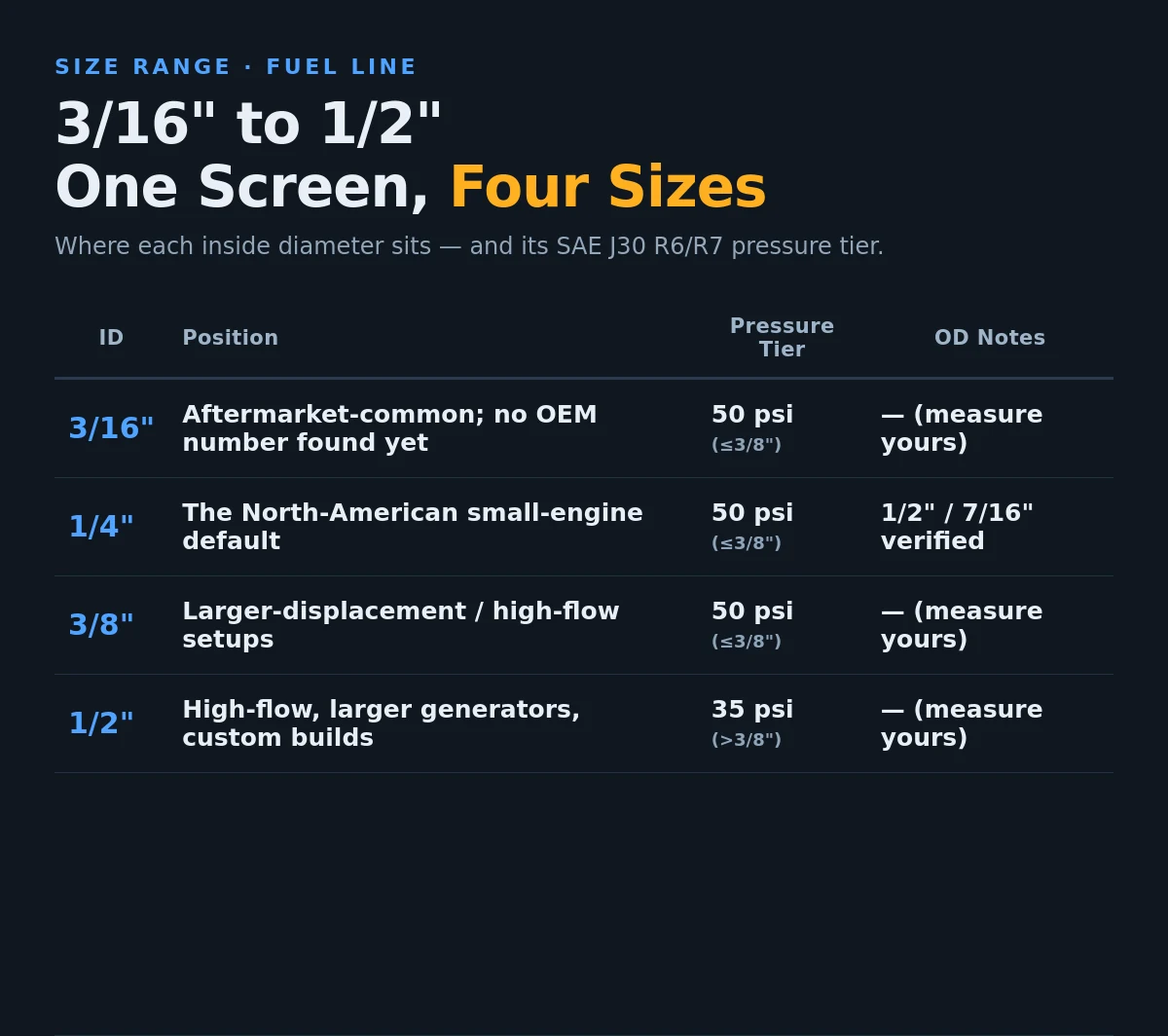
full size chart if you’re still narrowing it down.
Who Actually Needs a 1/2″ Line
1/2″ shows up on higher-flow setups: larger displacement engines, longer runs where flow resistance matters, and equipment that moves more fuel per minute than a mower does.
That’s a short list on purpose. For comparison:
- 1/4″ — the standard carbureted small-engine size. 1/4″ fuel line
- 3/8″ — larger displacement, mid-high flow. 3/8″ fuel line
- 5/16″ — EFI engines only. 5/16″ fuel line
- 1/2″ — high-flow setups. This page.
If your machine is a riding mower or a walk-behind, you almost certainly don’t need 1/2″.
The Spec Sheet for 1/2″ Fuel Line
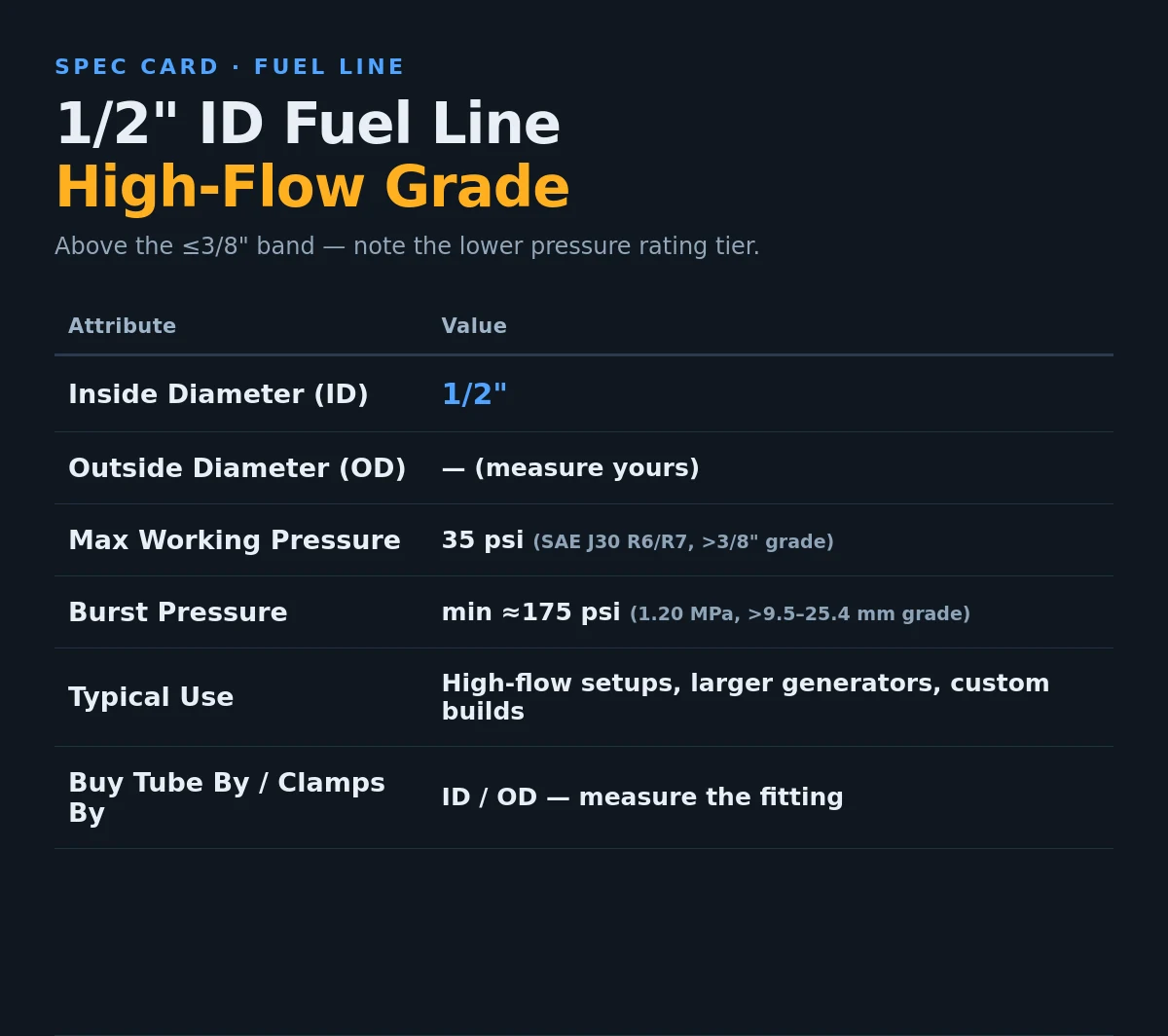
| Spec | Value |
|---|---|
| Inside diameter (ID) | 1/2″ |
| Outside diameter (OD) | — (varies by manufacturer; measure yours) |
| Working pressure | 35 psi max (SAE J30 R6/R7, 1/2″ sits in the >3/8″ band) |
| Burst pressure | 175 psi min (SAE J30 DEC2008, >3/8″ band) |
| Common applications | High-flow and larger-displacement setups |
Two things worth flagging:
The pressure rating is lower than the smaller sizes. SAE J30 splits its working-pressure table at 3/8″: sizes at or below 3/8″ are rated 50 psi, and sizes above it — including 1/2″ — are rated 35 psi, with a 175 psi minimum burst. A bigger hose does not mean a stronger hose.
Buy the hose by ID, the clamp by OD, and measure the fitting. Same rule as every other size on this site.
Flow Rate and Fitting Reality
Bigger hose, more flow — that’s the intuition. Here’s why it doesn’t hold up on a small engine.
A carburetor doesn’t need volume. It draws fuel through the line by vacuum and meters it through jets sized for the engine. The line’s job is to deliver fuel steadily, not to move as much as possible. Going oversized doesn’t feed the engine better.
Bigger ID means a looser fit on the same fitting. The hose slides on without resistance, the clamp has less to compress, and you get a seep or an air draw. Air in the line reads as a lean condition — rough running, hesitation, hard starting.
Oversized line can make flow less stable. In a gravity or vacuum-fed system, a large-diameter line holds more fuel volume and responds more slowly to demand changes. That shows up as inconsistent running rather than a clean, steady supply.
On the fitting side, two details matter with a hose this size:
- Cut square. A ragged end won’t seal against the barb no matter what clamp you use.
- Use two clamps on long or high-vibration runs. It’s cheap insurance against a fitting working loose.
Installing a Line This Size
The install is the same process as any other fuel line — the difference is that mistakes cost more on a high-flow setup.
Cut square and deburr. On a hose this thick, a ragged edge won’t seat and the clamp can’t compensate.
Wet the barb, not the hose. A drop of clean oil on the fitting slides the hose on without tearing the liner. Never use gasoline as assembly lube.
Seat it fully past the barb ring. A hose that stops at the tip of the barb looks installed and isn’t.
Two clamps on long runs. Vibration over a long span works a single clamp loose. The second clamp is cheap.
Check routing clearance. Larger OD means less room around engine components. Confirm the line isn’t touching a hot surface or chafing a bracket before you call it done.
Three 1/2″ Mistakes
1. Upgrading “for safety.” A larger line on a smaller fitting is a loose fit, and it has a lower pressure rating. Both are worse, not better.
2. Using the old hose as your ruler. Old line swells. It reads a size larger than it started. Measure the fitting.
3. Forgetting the pressure band. If you’re replacing a 1/2″ line, it’s rated 35 psi / 175 psi burst — not the 50/250 figures you’ll see quoted for 1/4″. Also: rubber fuel line isn’t graded by ethanol percentage, and above 5% oxygenate by volume permeation rises markedly (SAE J30).
FAQ
Is a bigger fuel line better?
No. Match the line to the fitting. An oversized line fits loosely, can draw air, and in the 1/2″ size carries a lower pressure rating than the smaller sizes.
What is 1/2 fuel line used for?
High-flow and larger-displacement setups — engines that move more fuel than a typical mower. It’s not a standard small-engine size.
What OD fits a 1/2 ID hose?
Outside diameter varies by manufacturer, so we don’t publish a fixed number. Measure your hose or the fitting with a caliper before buying a clamp.
Can I downgrade from 1/2 to 1/4?
Only if the machine’s fuel system was designed for 1/4″. On a system built for 1/2″, a smaller line restricts flow and won’t seal on the larger fitting. Match the fitting.
What pressure does 1/2 fuel line handle?
SAE J30 R6/R7 line in this size is rated 35 psi maximum working pressure with 175 psi minimum burst (DEC2008).
Need a high-flow fuel line? fuel line kits cover the common small-engine sizes — check the size chart above if you’re unsure which one you have.
*Ready to buy? Get the fuel line kit →*