
If you measured 3/8″, your machine probably isn’t the typical carbureted push mower — this size shows up on larger-displacement and higher-flow setups.
It’s also the size where ordering the wrong thing hurts most, because there’s less margin for a loose fit. Here’s how to buy it right.
Not sure you’re in the right place? full size chart has all five sizes side by side.
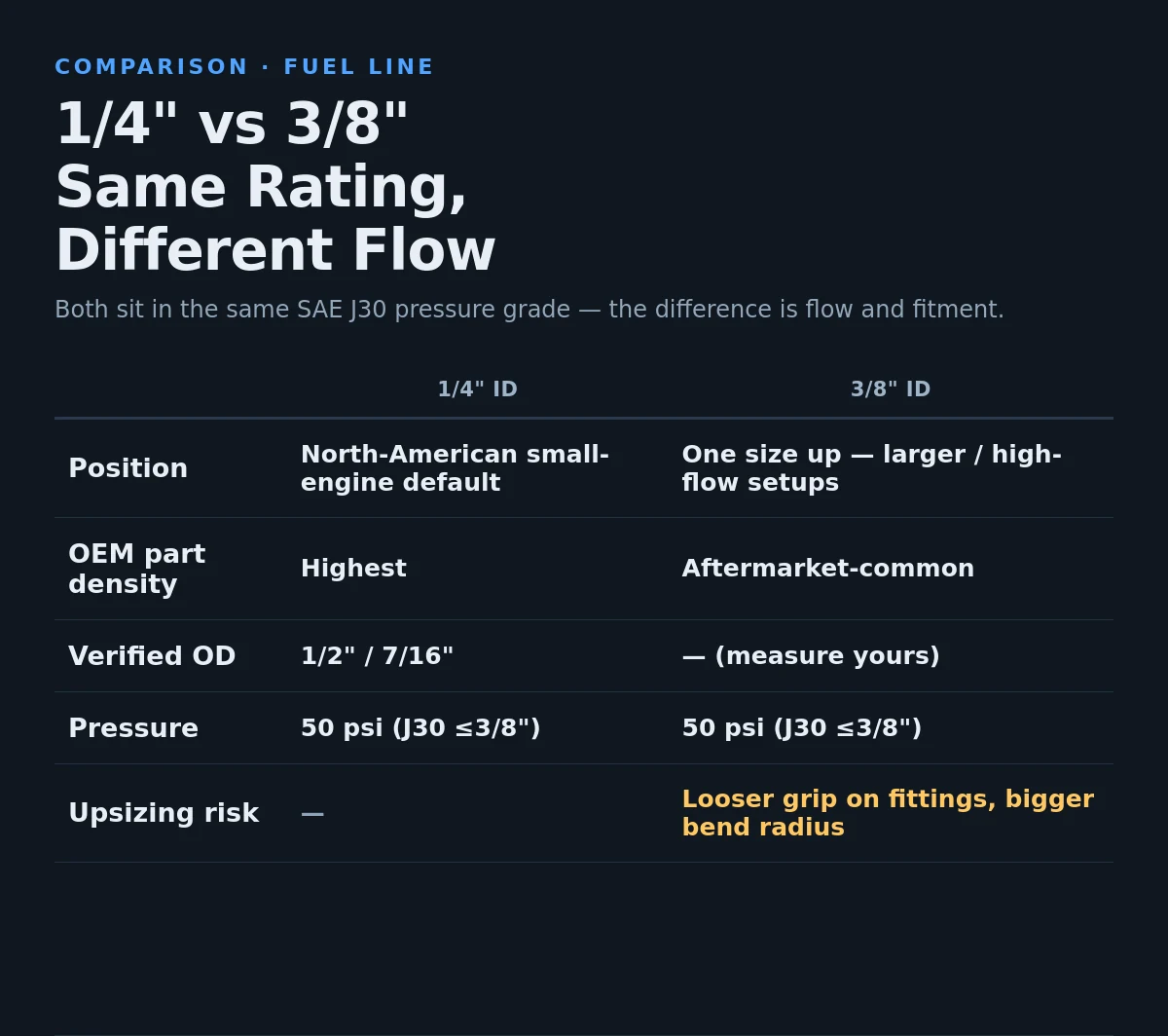
Where 3/8″ Sits in the Range
Three different sizes, three different jobs:
- 1/4″ — the most common carbureted small-engine size. 1/4″ fuel line
- 5/16″ — EFI engines only. 5/16″ fuel line
- 3/8″ — larger displacement and higher-flow setups. This page.
3/8″ isn’t a “better” size and it isn’t a fallback when 1/4″ won’t fit. It’s what a bigger fuel system needs — more flow area for an engine moving more fuel.
Machines and Setups That Use 3/8″
Straight answer: larger-displacement equipment and setups with higher fuel demand. That’s a deliberately broad description, because the specific machine list isn’t something we can verify across every brand and model.
What that means practically:
Check your parts list before you order. The machine’s own manual or parts diagram is the authority on fuel line size — not a chart on the internet, including this one.
Measure the fitting. If the parts list is unclear or the machine has been modified, the fitting on the carburetor or fuel rail tells you the truth. how to measure your fuel line.
Don’t size up to be safe. A larger hose on a smaller fitting doesn’t give margin — it gives a loose connection. More on that below.
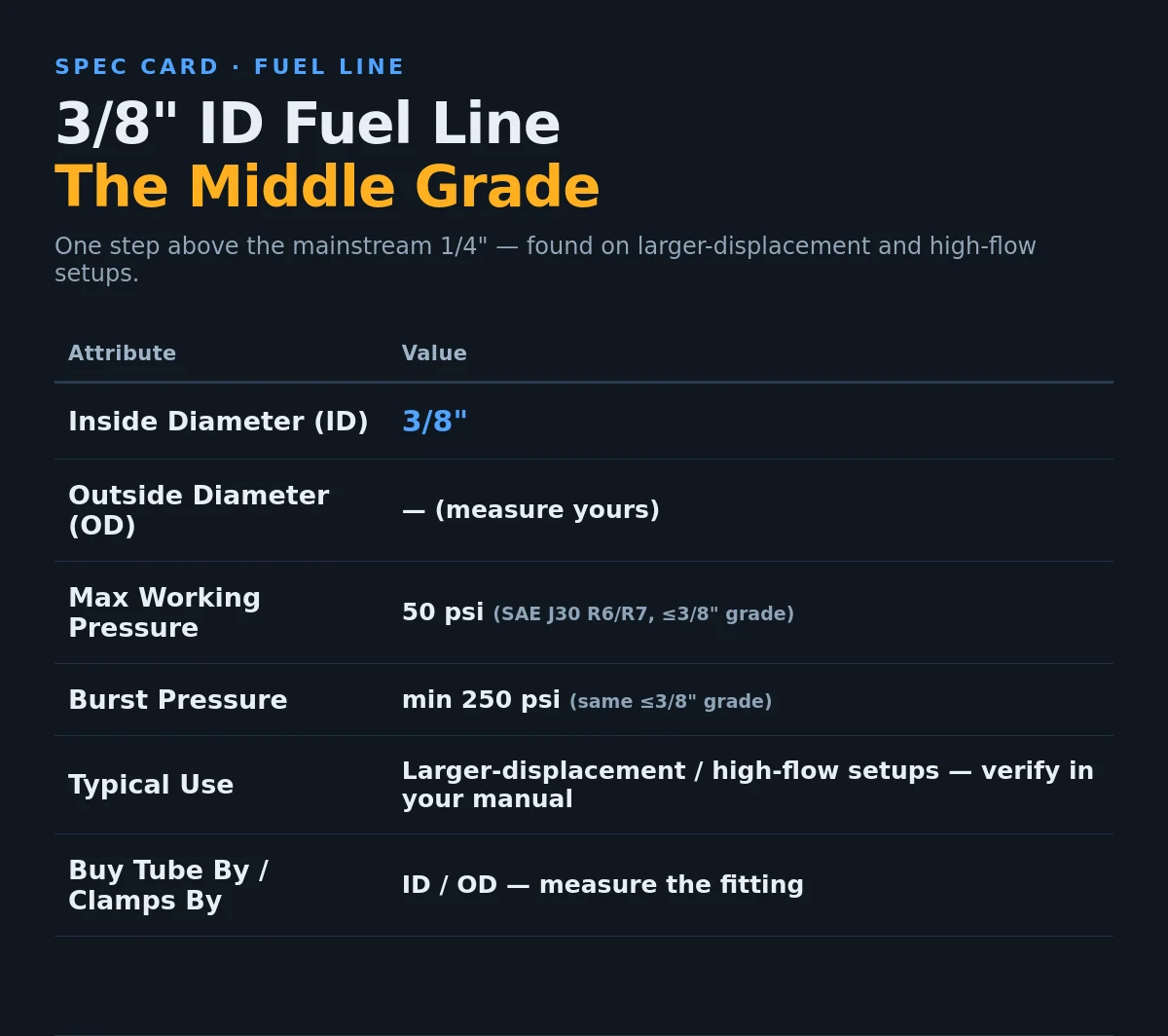
The Spec Sheet for 3/8″ Fuel Line
| Spec | Value |
|---|---|
| Inside diameter (ID) | 3/8″ |
| Outside diameter (OD) | — (varies by manufacturer; measure yours) |
| Working pressure | 50 psi max (SAE J30 R6/R7, 3/8″ sits in the ≤3/8″ band) |
| Burst pressure | 250 psi min (SAE J30 DEC2008) |
| Common applications | Larger-displacement and higher-flow small-engine setups |
Two things to carry away:
3/8″ is a larger-displacement size, not the mainstream one. If your machine is a standard carbureted mower, you probably want 1/4″.
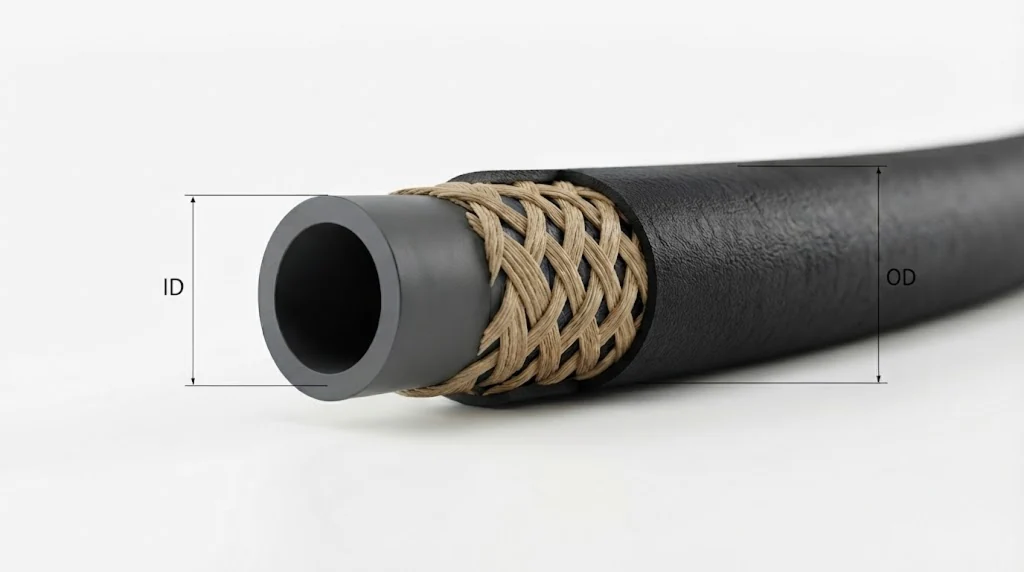
Buy the hose by ID, the clamp by OD, and measure the fitting — not the old hose. Those three rules cover almost every sizing mistake.
Flow, Fit, and Why Bigger Isn’t Safer
There’s an intuition that a bigger fuel line gives you more margin. It doesn’t work that way.
A larger ID on a smaller fitting is a loose fit. The hose slides on without resistance, the clamp can’t close the gap, and fuel seeps or air gets drawn in. On a carbureted engine, air in the fuel line reads as a lean condition — rough idle, hesitation, or a machine that won’t hold speed.
Forcing a smaller hose onto a larger fitting breaks it. The liner stretches thin over the barb and splits. You get a leak at exactly the connection you were trying to secure.
Flow isn’t the constraint. A small engine’s fuel demand is modest; the pump and carburetor are sized for that. Going up a size doesn’t feed the engine better — it just makes the connection worse.
The clamp has less to grab. A clamp sized for the proper hose compresses the wall against the barb. On an oversized hose, the wall is already loose — the clamp has to close a gap it wasn’t designed to close, and it usually can’t.
The bend radius changes. A thicker, larger hose doesn’t turn as tightly. Route it through a tighter path than it’s built for and you get a kink that starves the engine.
So: match the size to the fitting. That’s the whole rule.
Three 3/8″ Mistakes
1. Buying the next size up “just in case.” It’ll fit loosely and leak. Match the fitting.
2. Cutting the new hose to match the old one. Old line swells and stretches — it reads larger than it started. Measure the fitting.
3. Ignoring what’s in the tank. Rubber fuel line isn’t graded by ethanol percentage, and SAE J30 notes that once oxygenates pass 5% by volume, permeation rises markedly. If the machine sits with pump gas in it, check the line more often.
FAQ
Is 3/8 bigger than 5/16?
Yes. 3/8″ is a larger inside diameter than 5/16″. They also serve different systems — 5/16″ is specified for EFI engines, 3/8″ for larger-displacement setups.
What is 3/8 fuel line used for?
Larger-displacement and higher-flow small-engine setups. It’s not the standard carbureted mower size — that’s usually 1/4″.
What OD fits a 3/8 ID hose?
Outside diameter varies by manufacturer and wall construction, so we don’t publish a fixed number. Measure your hose or the fitting with a caliper before buying a clamp.
Can I use 3/8 instead of 1/4?
Only if your engine’s fuel system was built for 3/8″. On a machine that takes 1/4″, a 3/8″ hose is too loose and will leak or draw air.
What pressure does 3/8 fuel line handle?
SAE J30 R6/R7 line in this size is rated 50 psi maximum working pressure, with 250 psi minimum burst (DEC2008).
Need 3/8″ fuel line? fuel line kits cover the common small-engine sizes.
*Ready to buy? Get the fuel line kit →*