
Why Your “3/16 Inch” Fuel Line Leaks — and What Size Your Engine Actually Takes
You bought a 3/16″ fuel line. The package said 3/16″. The hose measured what the package said. You pushed it onto the carburetor fitting, clamped it down, and it still seeps.
Nothing is defective. The number on the package is real.
The problem is that “3/16” doesn’t mean one thing. On a handheld two-stroke it usually describes the outside of the hose. On a four-stroke engine it describes the inside. Same four characters, two completely different hoses — and the one you’re holding may not be the one your engine wants.
Once you know which kind of 3/16 you need, the leak usually disappears.
The Same Number Has Two Jobs
Here’s the split, and it explains almost every “but it says 3/16” complaint.
On handheld two-strokes — trimmers, chainsaws, leaf blowers — 3/16″ is usually the OUTSIDE diameter. The factory line on those machines is typically a 3/32″ × 3/16″ hose: 3/32″ inside, 3/16″ outside. When a parts listing says “3/16 fuel line” for a trimmer, it’s describing the OD. The inside — the part that actually has to grip the fitting — is 3/32″.
On four-stroke engines, 3/16″ is an INSIDE diameter. Predator 212 carburetor feeds and Ariens equipment are documented examples. Here the number describes the bore, and the outside is bigger.
That’s the trap. Buy “3/16 fuel line” for a trimmer and you may get a hose whose ID is 3/16″ — twice what the fitting needs. Buy for a four-stroke thinking it’s an OD spec and you go the other way.
There’s a second layer too: two hoses can share an ID and differ in OD. Homelite and Ryobi 3/32″ ID line runs about 13/64″ OD — noticeably fatter than the common 3/16″ OD. Same bore, different outside, different clamp.
Why the inconsistency? Because “3/16 fuel line” started life as a catalog description, not a specification. A hose maker lists the dimension the buyer recognizes: on handheld equipment that’s traditionally been the overall size you see when the hose is in your hand; on four-stroke equipment, where the line runs to a carburetor rather than a pulse fitting, the bore is the number that gets quoted. Both practices are decades old and both are still in use.
The result is that the same phrase on two product pages can describe two different hoses. That isn’t a scam or an error — it’s two industries’ habits colliding in one search box.

What Size Does Your Engine Actually Take?
Start with your engine, not the hose. Every number below is a reference for the machine, not a statement about what fits a ShineYoo product. For the full set of sizes side by side, see the fuel line size chart.
| Engine | Factory line (ID) | Closest inch equivalent | Notes |
|---|---|---|---|
| Honda GX160 / GX200 | 4.5 mm | 3/16″ (4.76 mm) | Closest inch size; about 6% larger than factory |
| Predator 212 | 3/16″ ID at the carburetor | 3/16″ | Four-stroke — here 3/16″ is a bore |
| Briggs & Stratton (common small engines) | 1/4″ (6.35 mm) | 1/4″ | Most B&S small engines |
| MTD handheld (2012+) | 3/32″ ID × 3/16″ OD | 3/32″ ID | The “3/16” here is the outside |
| Echo / Tanaka | 3 mm | 1/8″ (3.18 mm) | Not identical — 3 mm is slightly under 1/8″ |
| OEM kits (varies) | ID not published | — | Honest answer: we won’t print a number the maker doesn’t |
*OEM reference only — not a fit claim for ShineYoo product.*
A useful pattern, though it’s a habit-of-thumb rather than an official rule: Honda part numbers in the 95001 series encode the size — 95001-45xxx is the 4.5 mm line. It’s a memory aid, not a spec sheet.
If your engine isn’t listed, measure your old hose instead of guessing. If it turns out you need the most common size, the 1/4″ fuel line kit page covers it. It’s a two-minute job with a caliper and it beats every chart, including this one.

Why “Close Enough” Leaks
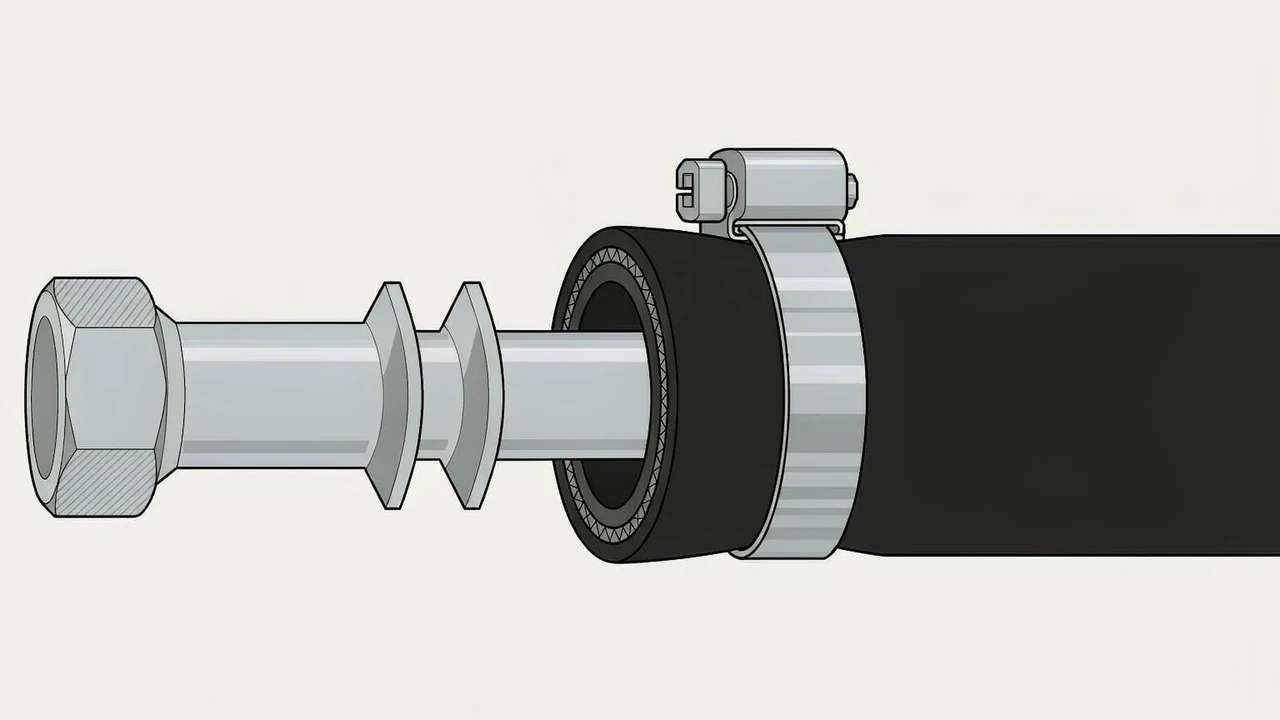
A fuel line connection is a barbed fitting, a hose pushed over it, and a clamp squeezing the hose against the barb. The seal depends on the hose’s inside diameter being close enough to the fitting’s outside diameter that the clamp can close the gap.
That gives us two very different failure modes, and the difference between them is why “close enough” sometimes works and sometimes doesn’t.
Six percent over is usually fine. Honda’s GX160/GX200 factory line is 4.5 mm. A 3/16″ hose is 4.76 mm — 0.26 mm larger, about 6%. The clamp can take up that much. Plenty of people run 3/16″ on a GX with no trouble.
Forty-one percent over is not. 1/4″ is 6.35 mm against that same 4.5 mm fitting — 41% larger. The clamp has nowhere near the travel to close that. So the hose sits loose, fuel weeps past the barb, or air gets drawn in and the engine runs lean. On OldMiniBikes forums this is reported repeatedly: a 1/4″ line on a GX160 carburetor leaks, a 3/16″ line fits.
So when someone says “1/4 works fine on mine,” they may be talking about a different engine with a different fitting. The percentage is what matters, not the fraction on the package.
Where the leak actually shows up. On a loose hose, fuel seeps at the base of the barb — you’ll see a wet ring right where the hose meets the fitting, often with a faint fuel smell before any drip. On a hose that’s too tight, the liner splits when you push it on, and the leak shows up as a crack running lengthwise from the end.
Why clamps don’t rescue a bad size. A clamp compresses the hose wall against the barb. It has a working range, and on a worm-gear clamp that range is maybe a few millimeters of circumference. Six percent of a 4.5 mm fitting is well inside that range. Forty-one percent isn’t close — the clamp bottoms out against itself before the hose ever contacts the barb properly.
Why vacuum matters as much as pressure. A carbureted fuel line doesn’t just carry fuel — it holds a slight vacuum that draws fuel from the tank. A loose fitting doesn’t only drip outward; it can pull air inward, which leans the mixture and shows up as rough idle or hard starting rather than a visible leak. That’s the failure mode that makes people chase carburetor problems for a week.
How to Get It Right
Three steps, in this order.
One: pull the old line and measure its inside diameter. Not the outside, not the printed number — the bore, with a caliper, at the fitting end. That is the one measurement that describes your engine.
Two: buy the size that matches the bore, not the size that matches the label on the old hose. Old line swells; the number that was printed on it years ago may no longer describe what it measures today.
Three: match the clamp to the hose’s outside diameter so it has room to compress.
One practical note if you’re shopping: fuel line in these small diameters is usually sold as a multi-size kit rather than one length of a single bore. That’s actually an advantage here. Handheld machines alone use several closely spaced IDs — 5/64″, 3/32″, 0.080″ — and if you own more than one machine, a kit covers the range without a second trip.
FAQ
Is 3/16 the same as 5 mm?
Close but not the same. 3/16″ is 4.76 mm. For a 4.5 mm factory line that’s about 6% over, which a clamp normally handles. For a 5 mm fitting, 3/16″ is slightly under.
Can I use silicone hose for fuel?
Not for fuel lines. Silicone absorbs hydrocarbons and swells. Use a hose intended for fuel.
How thin is a return line supposed to be?
Return and vent lines are often smaller than the supply line. Measure the fitting rather than assuming they match the supply side.
Does a vent line count as a fuel line?
It carries fuel vapor, so it needs fuel-rated hose. The sizing rules are the same — measure the fitting.
My old line is hard and cracked. What do I check first?
Check the clamp and the fitting end for the leak, then replace the hose. Hardened rubber won’t seal again even with a fresh clamp.
—
The one thing to take away: “3/16” describes the outside on handheld two-strokes and the inside on four-strokes. Measure the bore on your engine before you buy, and the leak problem mostly goes away.
ShineYoo fuel line kits cover the common small-engine size ranges with clamps included — 5-size fuel line kit · 6-size kit.
*Ready to buy? Get the fuel line kit →*