
The first warm Saturday of the season, the mower starts on the second pull and then you smell it: raw gas. Dark patch on the shed floor, wet shine down the side of the engine. You have decided to fix it yourself. What you have not decided is what to buy, and the shelf offers four sizes that look identical in the package. Most people grab the smallest, because the old line looked thin — the most common way a cheap repair becomes a second trip.
The short version: your mower’s fuel line size is set by the engine, not by the brand on the hood. Most push and riding mowers with a Briggs & Stratton or Kohler engine take 1/4 in inside diameter. Some EFI models use 5/16 in. The 3/16 in line sold as a universal replacement is a service-counter size, not something an engine builder specified. And no article can tell you what your particular machine takes without a look at the fitting.
The Size Is on the Engine, Not the Mower Brand
Two mowers side by side in the same shed can share a deck and a transmission and still need different hose: the engine determines the fuel system. Craftsman, Husqvarna, Toro, and MTD all buy engines from the same handful of builders, so the engine label answers the size question.
The label sits on the engine shroud: model number, serial number, family designation. Briggs & Stratton and Kohler publish fuel routing and line information by engine family rather than by the machine it was bolted into. That is why a parts counter asks for engine numbers even when you brought the whole mower in.
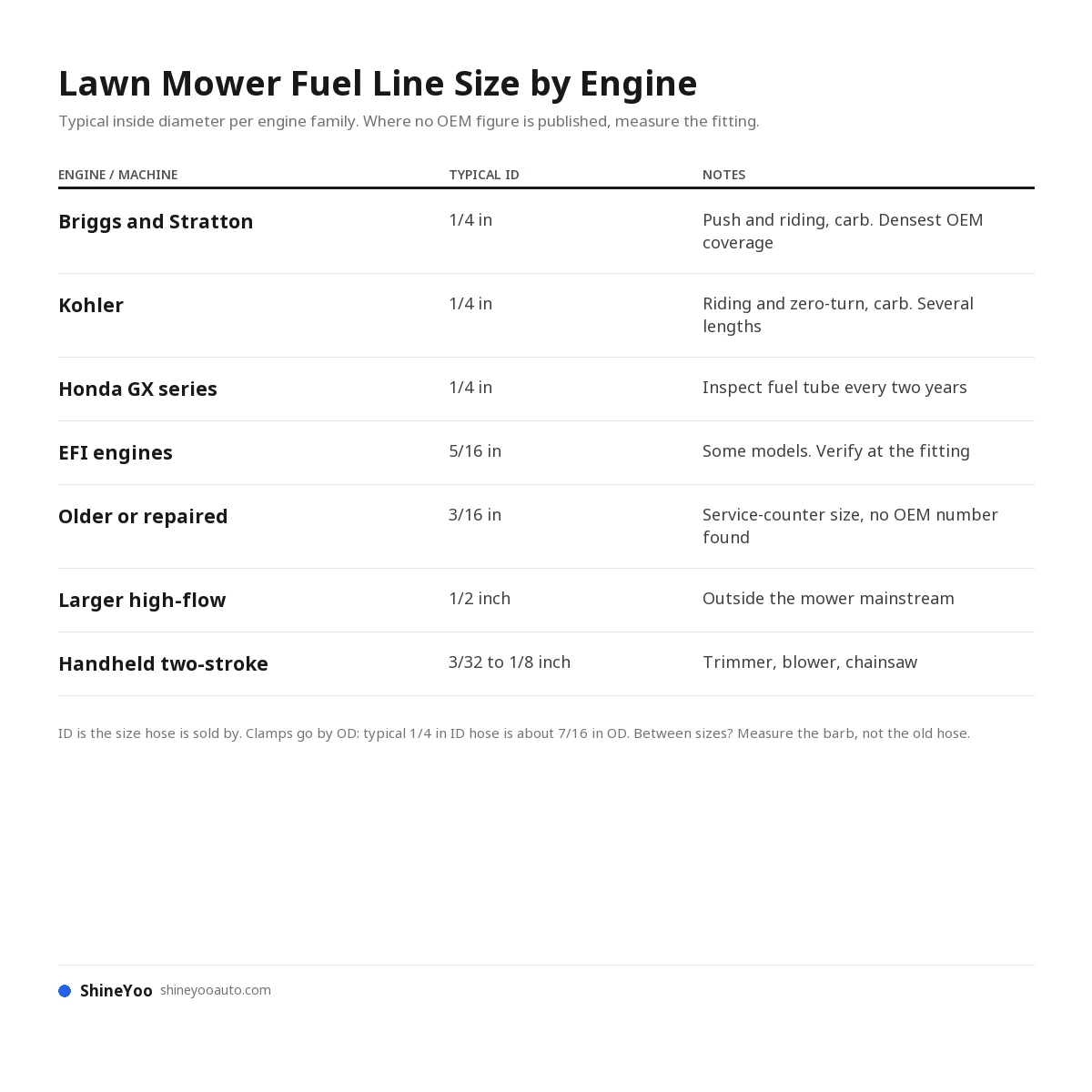
One distinction trips people up: hose is sold by inside diameter, the bore the fuel travels through; clamps are sized by outside diameter, which includes the wall and any reinforcement layer. Buy hose by ID, buy clamps by OD, and when in doubt measure the fitting instead of the old hose — old hose swells and stretches around every barb it has sat on.
A note on EFI mowers
Fuel injection changed the hose question along with the fuel system. An EFI engine runs higher pressure at the rail than a gravity-fed carburetor, which puts hose construction — not just hose size — under different demands. Some EFI mowers use 5/16 in line. Which models, and what rail pressure means for a given hose rating, we are not going to state flatly. If your engine is EFI, read the fitting and check the manual for that model.
What Size Do Most Mowers Actually Take?
1/4 in inside diameter — the mainstream size
Walk behind a row of push mowers and riding mowers at any dealership and most are plumbed in 1/4 in. It has the densest OEM part number coverage in this class: Kohler lists several lengths under one 1/4 in family, and Briggs & Stratton sells pre-cut lengths in the same size. If you own a carbureted mower and have no other information, check 1/4 in against the fitting first.
Typical 1/4 in ID hose measures around 7/16 in OD, which is also the clamp size you want. If the bead on your fitting measured roughly a quarter inch across, this is your line. The 1/4 in fuel line specifications are laid out separately, including wall thickness and clamp pairing.
5/16 in inside diameter — some EFI models
Covered above, and kept short on purpose. Do not treat a bigger hose as an upgrade on a carbureted engine. A 5/16 in line pushed onto a 1/4 in barb goes on, looks fine, and eventually seeps — the clamp is holding a hose a full size larger than the fitting under it.
3/16 in inside diameter — a service-counter size, not a factory standard
The 3/16 in line is everywhere in the small engine aisle, sold in coils and blister packs as a universal replacement. It is a real size and does fit some machines, usually older or smaller equipment where a previous repair swapped the original for whatever was on the shelf.
What it is not: a factory standard for mowers. We looked for an OEM fuel line part number in 3/16 in and did not find one. That distinction matters, because “everyone uses it” and “the engine was built with it” are different claims, and only the second should drive what you buy. If your line measures 3/16 in and it was not you who put it there, verify against the fitting before buying the same size twice. The failure mode of an undersized line is covered in why 3/16 in fuel lines leak.
Larger setups and small handheld equipment
Two edge cases. Some larger engines and high-flow setups run 1/2 in line, outside the mower mainstream and covered by the larger size class. Handheld two-stroke equipment — trimmers, blowers, chainsaws — uses much smaller line, commonly 3/32 in, 1/8 in, and .08 in. That is why your trimmer takes a straw and your mower takes something closer to a garden hose: different architecture, different fuel delivery, different bore.
If your measurement lands between sizes, or the fitting has a barb a 1/4 in hose will not stretch over, do not force it — step up and check again. A hose that has to be heated and shoved is the wrong size. The full method is in how to measure fuel line correctly; the full fuel line size chart covers classes this article does not.
When to Replace — What the Engine Makers Actually Say
Three major small engine builders publish intervals, and they disagree. That reflects different materials and service networks, not an error.
Kohler calls for fuel system service, including line replacement with the specified low-permeation hose, at 200 operating hours.
Honda takes a calendar approach: on the GX series, inspect the fuel tube every two years and replace if necessary. Inspection first, replacement conditionally.
Briggs & Stratton publishes no fixed interval — judge the line by condition, which puts the decision on your eyes rather than an hour meter.
Kawasaki and Toro do not publish a line replacement interval for their small engines at all. Anyone quoting one number for every mower is quoting something that does not exist.
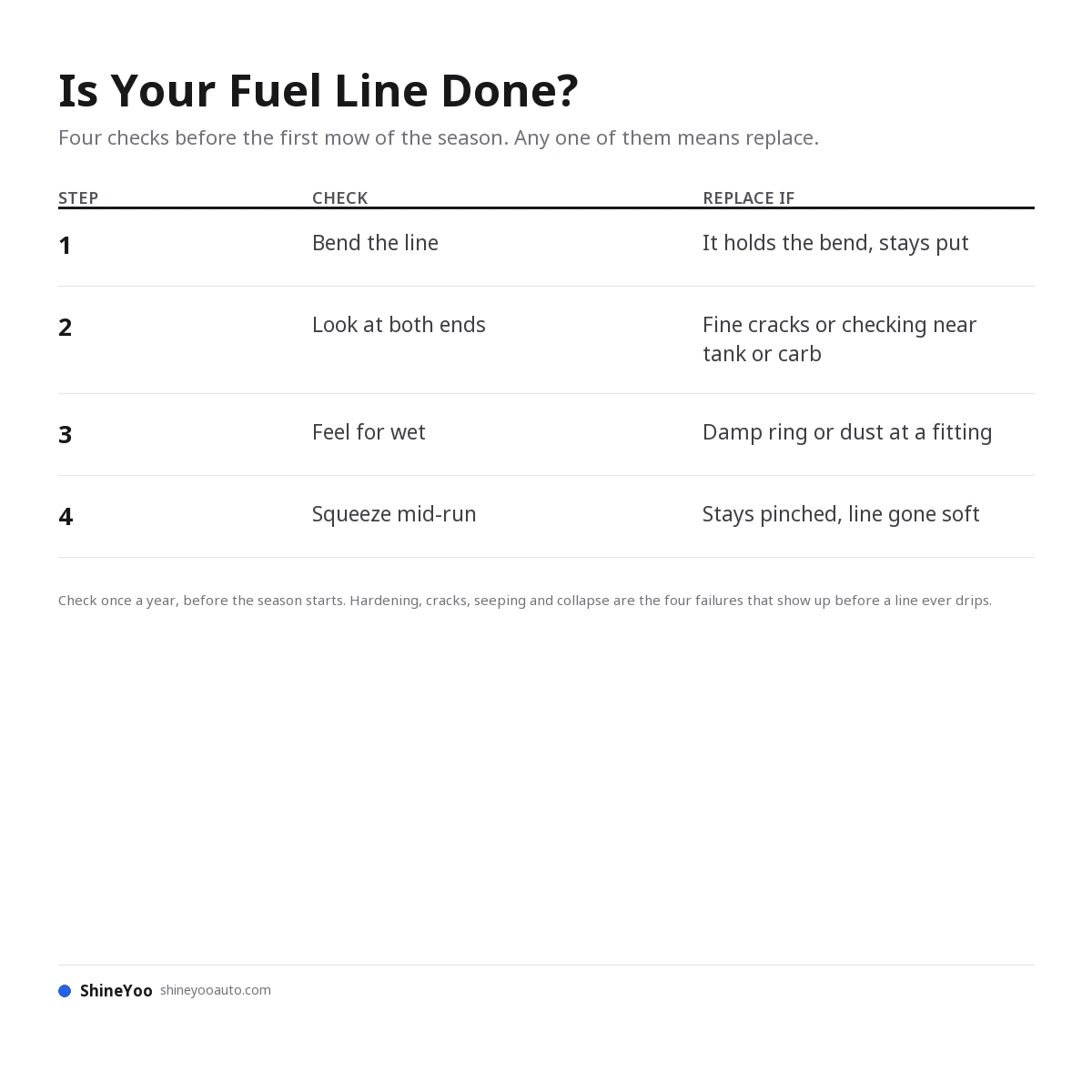
Since two of three major builders leave it to condition, condition is what you should learn to read. Four things, checked once before the first mow of the season:
- Hardening. Bend the line. Fuel hose should flex like a stiff rubber band. If it holds the bend and stays put, the plasticizer has left the material.
- Cracks. Check closest to the tank outlet and closest to the carburetor, where the hose has been stretched longest. Fine surface checking turns into through-wall cracks from the inside out.
- Seeping. A line can leak without dripping. A damp, dust-attracting ring at a fitting, or a faint fuel smell nothing else explains, is a leak.
- Collapse. Squeeze the line mid-run. If it stays pinched, the liner has softened and the line is restricting flow under vacuum.
Why do lines fail this way? Pump gasoline carries oxygenates, and ethanol is hygroscopic — it pulls water out of the air in the tank. That water sits against the inner wall while rubber absorbs fuel components through it. The material swells, plasticizer migrates out, the rubber hardens, and micro-cracks form on the bore side first. A line that passed a visual check last spring can seep by midsummer — which is why the check matters more than the calendar.
Related: SAE J30R6, the low pressure specification most small engine hose is built to, sets the working pressure ceiling at 50 psi for hose up to 3/8 in ID and 35 psi above that, design temperature up to 100°C / 212°F. Those are rating figures, not what your mower produces — gravity feed and a small carburetor run at a fraction of the ceiling, which is why condition fails first on a mower.
Swapping It Yourself, Start to Finish
Short job; the order matters more than the speed.
Shut the fuel off first: the inline valve if the mower has one, a proper pinch tool on the line, or run the engine dry with the tank low. Rag and a small container under the tank outlet before you pull anything. Gasoline onto a hot muffler is the one part of this job that can hurt you, so let the machine cool and work outdoors.
Then one end at a time. Cut the old line free at the tank outlet rather than yanking, and look at what it sat on: barb diameter, whether the fitting is original or a repair, whether the line was clamped or just pushed on. That look is the sizing information this article keeps pointing at.
Fit the new line dry first to check length. Warm the end in hot — not boiling — water for ten or fifteen seconds before pushing it onto the barb; a softened hose seats in one motion, a dry one tears at the inner wall going on. Push until the hose passes the bead, not just up to it.
Clamp placement is where home repairs usually go wrong. Seat the clamp a few millimeters back from the hose end so the band sits on solid material, not the edge, and aim the screw so you can reach it later. Route the line away from the muffler and cylinder head, keep it off shroud and frame edges — a line that chafes through in one season has a routing problem, not a hose problem.
Before the covers go back, turn the fuel on and watch the joints for a full minute. A seep shows up as a slow darkening, not a drip.
FAQ
Can I just use any hose from the hardware store?
No. Clear vinyl tube sold by the foot is not fuel hose — it hardens, discolors, can soften in contact with gasoline, and is not built to SAE J30R6. Fuel hose is a specification, not a shape. The difference shows within one season.
Is 3/16 in the standard size for lawn mowers?
It is a common aftermarket replacement size, but not a factory standard we could confirm — no OEM fuel line part number in 3/16 in turned up for mower engines. Treat it as a size that fits some machines, not the size mowers are built with.
How do I know if my mower is EFI?
Look at the engine label and the intake. A carbureted engine has a bowl and a fuel solenoid; an EFI engine has a throttle body with an injector and a visible fuel rail or high-pressure line. If the label says EFI, confirm the size at the fitting instead of assuming 5/16 in.
Why did my new line crack in one season?
Three usual causes: the hose was not fuel-rated, the routing put it against a hot surface or a chafing edge, or the size was wrong and the hose was stretched past its limit onto a larger barb. Line stored dry for years before installation also starts out aged.
Do I need to replace the filter and clamps too?
Usually yes on the clamps — the old one sat at one tension for years and its spring has taken a set, so a new clamp holds a new hose better. Replace the inline filter whenever the line is off; the system is already drained.
Before You Order
Take one photo: the old line still attached, fitting at the tank outlet in frame. That photo, the engine numbers off the shroud, and a caliper reading across the barb are everything a counter needs — no guessing between a quarter inch and five sixteenths.
If you would rather start from a box covering the common sizes — hose and clamps together — the 6-size fuel line kit takes the sizing question off the counter.